Christmas Miracle to Ukraine

What was this event about?

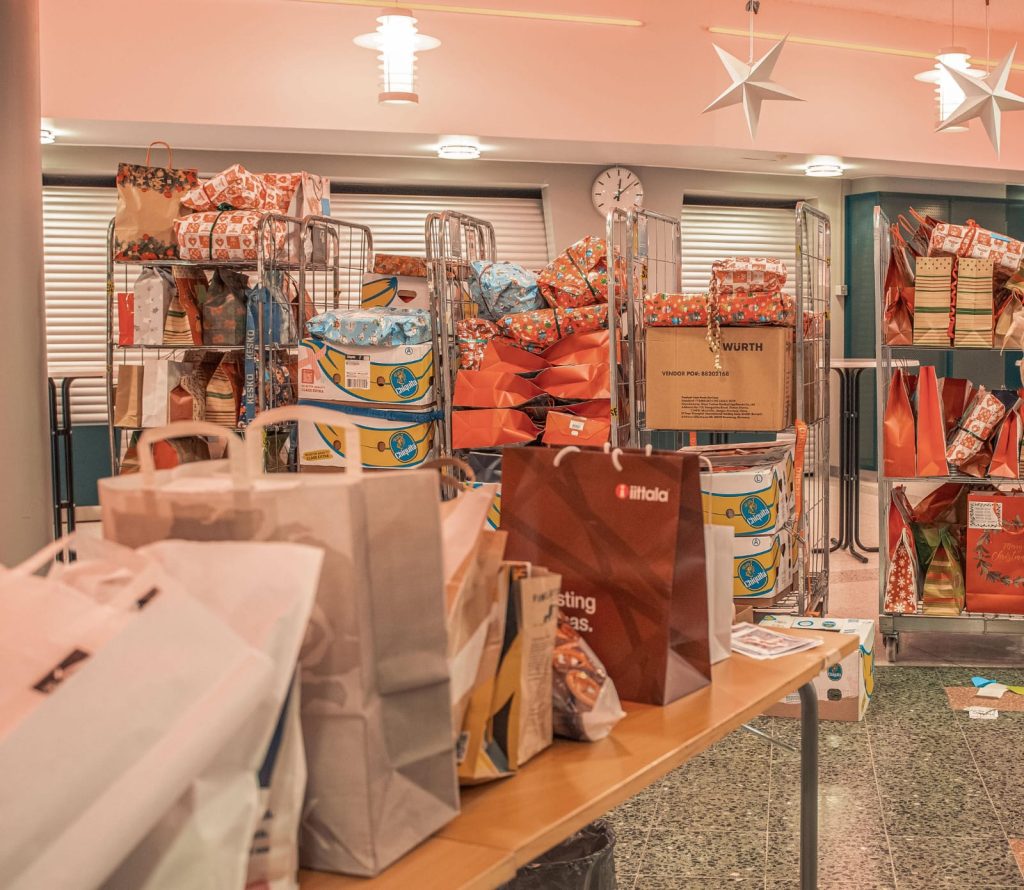
At the end of November some students from Soteekki participated in a Christmas present activity. It was organized by Ohjaamo in collaboration with the Diakonia University of Applied Sciences. The idea was, to send Christmas presents to children in the Ukraine. So, people from the area of Pori could bring gifts and we – meaning, all the volunteers – would then put together nice packages with different items and wrap them.

The whole event lasted for one week. Of course, this doesn’t include all the preparations that have been done in advance by the organizers. On Monday and Tuesday people could bring their gifts. During those two days, as well as on Thursday, all the presents were wrapped. Finally, on Friday, the packages were loaded to the truck of Fida International and shipped to Ukraine.

What did the students of Soteekki do there?

The students of Soteekki were offered the opportunity to work on this project for the week and gather working hours and receive a certificate. Once we arrived, we helped in all the different activities. We were there to receive the presents and thank the donors. A big part of our work was to help with the present wrapping. Finally, we also packed the packages into huge boxes to store them safely for their journey.

What do the students think about the event?

It was a very lovely experience. There were so many people donating presents – especially handmade wool socks. It was heartwarming to meet the people who just spent their money for kids they don’t know and from whom they won’t get any reaction or a personal thank you. Wrapping the presents was sometimes very hard, as there were also items like teddy bears or toy tractors. However, we had a lot of fun and it was good to practice our skills as Christmas time was coming up.

What is happening to the presents now?

The presents were shipped to the Ukraine and arrived there at the beginning of December. Fida International distributed the presents to children living in the front line and to orphans. You can find more information of the journey of the presents under “Ukrainan Kansalle” on the internet and Instagram.

https://ukrainankansalle.fi/

https://www.pori.fi/uutinen/etusivun-uutiset/ohjaamo-porin-ja-diakonia-ammattikorkeakoulun-monikulttuurinen-ohjaustyo-ohjaamossa-hankkeen-christmas-miracle-to-ukraine-joululahjakerays-onnistui-yli-odotusten/24/11/2023/

https://www.diak.fi/hakeminen/?gclid=EAIaIQobChMIp9SZ2rb_ggMVDQCiAx2iygGIEAAYASAAEgJSZfD_BwE

https://ohjaamot.fi/?utm_source=GoogleAds&utm_medium=search&utm_campaign=ohjaamoviikko23&gclid=EAIaIQobChMIv5-lz7b_ggMVNReiAx2k-gcaEAAYASAAEgKVnPD_BwE

https://www.instagram.com/ohjaamo_pori/

Foto from: sunfish.photography

#christmaspresentstoukraine

Writers: Anna Hagmann, Vilma Kaisla & Jemina Nurminen

Finnish Independence Day 6.12.

What is Independence Day?

Independence Day is celebrated in honor of Finland’s independence in 1917. Finland has been under Swedish rule and joined the Russian Empire in 1809. When the Russian emperor fell down in November 1917, Finland’s independence began to progress. Finland’s declaration of independence was approved by the parliament in 1917. Independence Day is a serious celebration in its background, which related to commemorating the war and those who fell in the war. Independence Day is celebrated on December 6. annually, which is a public holiday that is observed as a paid day off nationwide. In 2023, independent Finland will turn 106 years old.

How is Independence Day celebrated?

Since the time of the first president of Finland, the tradition has been the Independence Day Reception at the Presidential Palace, the parade of the Finnish Defense Forces and torchlight processions, such as the parade of scouts and high school students. Other Independence Day traditions include the Independence Day service, the raising the flag of Finland at Tähtitorninmäki, the children’s Independence Day party, showing of the movie Unknown Soldier, a visit to the hero’s graves and the cemetery, and the lighting of two candles. In terms of music, the national anthem, the Porilainen march, the Finlandia anthem and the veterans’ evening shout are essential to Independence Day.

Independence Day celebrations in Satakunta:

Pori

– 5.12. Patriotic concert at 18-19.30 pm, Central Pori Church

– 6.12. Ice show, 12-14 pm, Enersense Arena

– 6.12. Independence Day celebration, 13.00-15.00 pm, Promenade Hall

Kankaanpää

– 6.12 Independence Day celebration, 10-14 am, Kankaanpää Church, Kankaanpää Hall

Nakkila

– 6.12. Independence Day concert, 10-12.30 am, Nakkila church

Harjavalta

– 6.12 Independence Day celebration, 10-13.45 am, Harjavalta Church

What does an independent Finland mean for us in Soteekki?

For us, independent Finland means freedom, pride in our own country, having our own language and culture. The safety of walking outside. Freedom of choice, democracy. We can be our own country and we do not have to be under control by any other country. And of course, a paid day off or a double paid working day.

Writers: Hagmann Anna & Kaisla Vilma

Bright light lamps

Bright light lamps, do I need that?

When I – as a foreigner – heard about the bright light lamps for the first time, I was sceptical about it. I didn’t believe that these lamps should really help with my tiredness, as I didn’t even accept that my sleepiness was coming from the lack of sunlight (against what the lamps help). Nevertheless, I started reading about bright light therapy and started to see the logic behind it. Eventually, I tried working in front of such a lamp and it helped me a lot to get over my tiredness. So, in the following, you will see all the information, that made my try the lamp and an explanation on how to use it, if you get convinced, too!

Let’s start at the beginning. Every human being underlies different cycles, which influence sequences and processes in the body. Many of those cycles repeat themselves after one day. For that reason, they are called circadian (circa = about, dia = day) rhythms. One, for this article important circadian rhythm, is called sleep-wake cycle.

The sleep-wake cycle influences the human’s energy and activity levels and is affected by environmental cues, such as sunlight. Therefore, when the body is exposed to sunlight, serotonin is produced, generating alertness, and helping us to stay awake and active. At night, when the light outside diminishes, the internal clock initiates the production of melatonin, helping the organism to fall – and stay asleep.

However, what happens at this time of the year, as there is not much daily sunlight and most of the daytime is spend indoors? Logically, we won’t get enough sunlight. This causes an inadequate production of serotonin and melatonin, which in turn, leads to tiredness, fatigue, lack of motivation and in severe cases even to depression and insomnia.

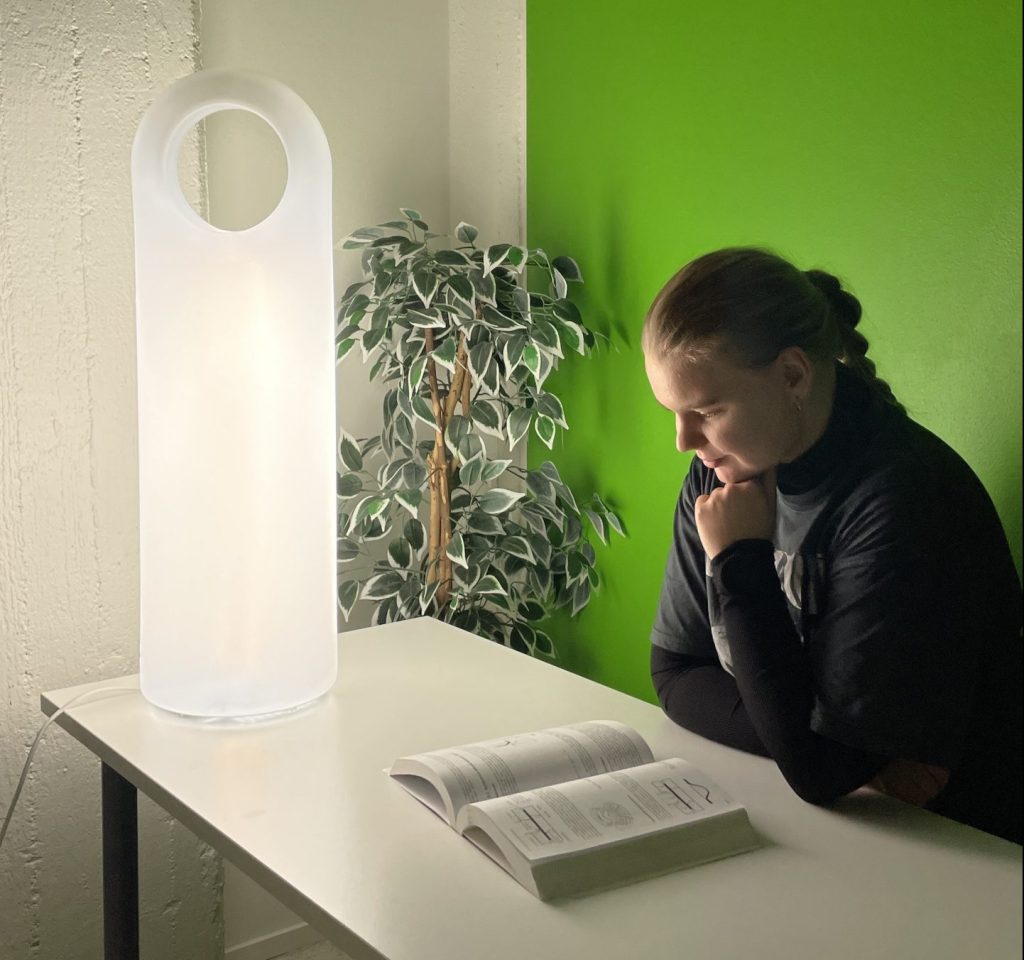
This is where bright light therapy comes in. Bright light lamps mimic the natural sunlight and can therefore start serotonin and melatonin production, too. They replace the lost sunlight and help us to have more energy and positivity during the day and allow us to fall asleep easier at night. Thereby, bright light lamps can not only be used to replace lost sunlight due to the fall and winter season, but also help with various disorders such as SAD (= seasonal affective disorder), depression, dementia or even jet lag.

Finally, how should you use these lamps?

There is still a lot of research going on about that topic and it also depends on the reason for using the bright lamps. However, for the replacement of sunlight and activation of the body system, it is suggested to sit every morning at least 30min in front of the lamp. You should never look directly at the lamp, but your eyes should always be opened, so a simple reading, working or even eating would be possible.

If you now want to try it as well, you will find the bright light lamps in the SAMK Library every weekday (Monday to Friday). From Wednesday to Friday, there will be a program near the lamps from 08:00 to 10:00 am.

https://www.sleepfoundation.org/circadian-rhythm

https://www.day-lights.com/homepage/how-light-therapy-works/

Writers: Anna Hagmann, Vilma Kaisla & Jemina Nurminen

Parenthood in health care sector 

Combining work, study and family life can be a real challenge for many families and single parents. Many people think about family life with burning questions such as “Do I want children?”, “Will I have enough money to support a child?”, “What will happen to my job?” or “What will my future be like?”. People often think that once they have a child, the rest of their lives will come to an end and they will no longer have the time and energy to work, study or meet their friends. For these reasons, having a child is often portrayed in a negative light on social media. However, it is possible to reconcile studying, working, and having a family. Reconciling career, family and studies requires a family-friendly and non-discriminatory working life, equal responsibility for care, home and related meta-work, and quality early childhood education and other family services and support networks. It is therefore possible to dream of a new career and other things that matter to you, even in a family with children. Parenthood can create new and different goals and dreams. Creating a family does not have to mean breaking off a career or giving up dreaming. 

We conducted a little survey of parents who were studying at the same time. Our first question was about applying for a career in care. All respondents agreed that the care sector offers a good employment situation, their own interest in the sector and also the people-oriented nature of the sector came up in their answers. 

Having a child during studies was not perceived as a major problem, even though studies were postponed. Some had already completed courses in advance. Majority of the respondents are not currently in employment. 75% of the respondents felt that their own ability to cope was satisfactory and 25% good.  

We also asked about time use and need for help. All respondents needed a lot of help with their children. Help comes from for example their own parents. Time management is perceived to be good, although there is little contact with friends and other social life. In the care sector, pay has recently been in the headlines in the media. Most respondents felt that a carer’s salary is not enough to support a family. However, the combined income of themselves and their spouse is enough to support the family. People feel that they miss out on their children’s development when they are at school and working. 

Here’s another list of tips for coping with peak years 

1. Boost your self-esteem, for example by listing your successes. 

2. Recognise your limits and strengthen your resources, for example by identifying what makes you more resilient and energetic. 

3. Increase your self-esteem, for example by making a list of your strengths. 

4. increase your self-compassion and see the good side of things, for example by keeping a diary in which you write down three things every day that you are grateful for or that you think have gone well. 

5. Don’t be alone, seek support from your family, networks or society. 

Sources: 

https://www.mothersinbusiness.fi/tyo-ja-perhe-eri-elamantilanteissa

Tattoos in Social and Health Care

History of tattoos

It is impossible to say exactly where the tattoos came from. Tattoos have been done for a long time all over the world. Tattoos have been widely associated with crime and in the past tattoos have been used to mark prisoners, soldiers, sex workers and others.

The earliest signs of tattoos can be seen as far back as 10 000 years in different human cultures. Different tattoo cultures exist in different parts of the world. Tattoos have appeared in Europe as early as the 1700s and 1800s. The so-called “new tattoo” appeared in the West in the 1960s and in Finland later. The purpose of the modern tattoo is to shape the body and to reflect the individual’s own identity.

In ancient times, tattoos were made by breaking the skin of the area to be tattooed with a fish tooth, a sharp stone, a sharpened bone, or a wooden stick. It was not until the 1700s that the Maori (or indigenous people of New Zealand) began to use metal needles to tattoo, making the images more symmetrical.

In Finland, the first official tattoo studios were established only in the late 1980s, because until then the health authorities refused to give permission, citing health concerns.

Tattoos today in Social and Health Care

Today, tattoos have become more common in the world and their visibility in the street scene is quite widespread. People’s attitudes towards tattoos have changed over time, as tattoos have become part of people’s identity and many people want to express themselves through their images.

Previously visible tattoos may have had an impact on getting a job and may have prejudiced the jobseeker. For example, tattoos may have been associated with crime, different religions and even evil spirits. Today, there is a more tolerant attitude towards tattoos and tattoos should not affect access to employment in the social and health sectors. However, some people, especially older people, may still have assumptions about tattoos.

Benefits of Tattoos in Social and Healthcare

Tattoos are body modifications, body art or art therapy.

  • Individuals with tattoos have a high esteem or self-image.
  • Improves the individual’s perception about themselves.
  • Gives individual the feeling of belonging to a community that is important to them.
  • Boost the immune system because when you get a tattoo your body believes you’re being wounded, thus your immune response kicks into gear and your body acts to defend you from invaders, heal the wound and protect you.
  • Getting tattoos helps you to adapt to stressful situations and potentially enhance the body to release less cortisol under future stress (HUSH Anesthetic, 2021).

Risks of Tattoos in Social and Healthcare

  • Persons with tattoos can experience discrimination, depreciation and prejudice.
  • The application process damages the skin causing blood clot around the broken blood vessels and creating a bruise.
  • Causes aseptic inflammation.
  • Can cause allergic reactions and hypersensitivity due to the tattoo ink because the inks contain substances that can cause allergies (green ink-chromium, blue ink- cobalt and yellow ink-cadmium)
  • Tattoos can lead to keloids which are formations of fibrous scar tissue caused by excessive tissue repair in response to trauma or incision.
  • Tattoo colors promote cell stress and weaken mitochondria function. For instance, the black tattoo dye contains benzopyrene, phenol concentrations and polycyclic aromatic hydrocarbons that reduce the mitochondrial activity of the skin cells thus limiting its health.

Soteekki students interviews

Anonymous

  1. What tattoos means to you?

Tattoos are means of self-expression and what I like. I want to showcase my relationship with my family through them.

  • What kind of reactions you have got from clients or colleagues about your tattoos?

Most of them thought it’s cute as they were small and not overly complicated in design.

  • What word comes first in your mind when you hear a word “tattoo”?

Self-expression.

  • What is your motivation for doing tattoos?

Memories that I always want to cherish.

Yalin

  1. What tattoos means to you?

It means that they’re a part of me and they all have individual meanings that’s why I got them.

  • What kind of reactions you have got from clients or colleagues about your tattoos?

Most of them thought it was cool that I got, and some said it was a shame that I inked my skin, asked me why I would do that to myself which was mainly older people.

  • What word comes first in your mind when you hear a word “tattoo”?

I think about myself when I hear it.

  • What is your motivation for doing tattoos?

I started when I was 17 and I started doing it because of my father who passed, but I couldn’t stop getting them after that.

Lähteet

https://www.ncbi.nlm.nih.gov/pmc/articles/PMC5868782/

https://www.ncbi.nlm.nih.gov/pmc/articles/PMC5632599/

https://hushanesthetic.com/blogs/community/health-benefits-of-tattoos

http://www.artlinetattoo.com/

Fall 2023 first Soteekki group

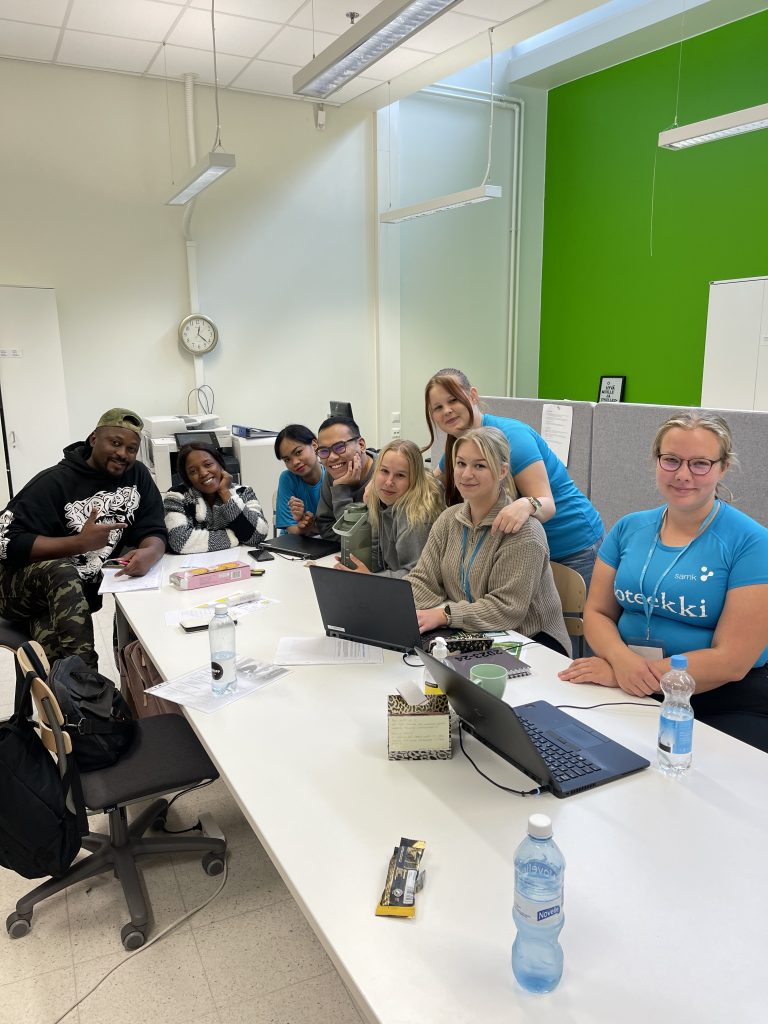
This post is written by three social work students, and we want to tell what is involved in a multi-professional entrepreneurship internship at Soteekki. In total, 133 hours are allocated to the entrepreneurial internship in the social work sector, including initial information, final feedback, orientation and writing the internship report.

At Soteekki, we work in a multidisciplinary team together with nurses and physiotherapists. Students on the English-language course also do their training at Soteekki, so you will certainly have the opportunity to discuss and implement plans in English. Soteekki is a great opportunity to learn social vocabulary in English.

Social workers work with different groups of clients, such as the elderly, children and people with intellectual disabilities. Working days include planning and implementing services. Currently in Soteekki, Monday and Tuesday are reserved for service planning and the rest of the days for actually doing the service. From a social worker’s point of view, visits to clients must always be client-oriented, listening to the client’s wishes and working in cooperation with other members of the team.

As in the field, you can plan and write reports, so if you are thinking about working as a supervisor you can learn about paperwork here. Students are mainly responsible about planning and implementing the services. But you can always ask for help!

Interviews:

We interviewed students from different programs about Soteekki internship.

Two social service students:

What are you studying and for how long your practice is going to last? – We are studying Bachelor of social services and our practice is 5 weeks long.

How do you bring your own expertise in Soteekki? – We approach the client in a holistic way and bring our social skills to the services. We also bring good energy to the work community.

What is the best thing in Soteekki? – Definitely the people and free coffee. Nice clients and services are also best.

Nursing student:

What are you studying and for how long your practice is going to last? – I’m a nursing student and my practice in Soteekki lasts 5 weeks.

How do you bring your own expertise in Soteekki? – I always focus on the client’s overall well-being and safety.

What is the best thing in Soteekki?  – The best thing about Soteekki is working with students from different programs, because you get to see and share different perspectives with others.

Physiotherapy student:

What are you studying and for how long your practice is going to last? – I’m a physiotherapy student and my practice lasts 6 weeks.

How do you bring your own expertise in Soteekki? – I always try to find something physical to do with the client and try to bring my own expertise to the service.

What is the best thing in Soteekki? – As students we are responsible for all the planning and doing, so you learn a lot and get to work with students from different programs.

Soteekki’s autumn season has gotten off to a good start, and services are being implemented and planned at a good pace. Practice in Soteekki goes by really fast when there is a lot to do. We wish everyone a good continuation of autumn!

World Parkinson Day – 11th April 

Written by Italian Physiotherapy student Sara Giovanardi

April 11th is the birthday of Dr. James Parkinson, the first physician to recognise Parkinson’s as a medical condition. 

In 2005 the tulip was adopted as the official symbol of Parkinson’s during the 9th World Parkinson’s disease day conference. However, the flower had been informally associated with the disease for more than 20 years prior to that. 

In fact in 1980, a Dutch horticulturalist named J. W. S Van del Wereld, who was living with Parkinson’s, developed a new red and white variant of the tulip and he named it the dr. James Parkinson tulip, in honour of the doctor. 

Today wearing the red tulip raises awareness and shows support for people living with Parkinson’s and their family globally. 

About Parkinson’s disease 

It’s a progressive disorder that affects the nervous system and causes unintended or uncontrollable movements. Symptoms usually begin gradually and they may be barely noticeable but they worsen over time.  

Anyone could be at risk for developing Parkinson’s but some research suggest this disease affects more men than women even though it’s unclear why. 

One clear risk is age: most people with Parkinson’s develop the first symptoms after age 60, about 5-10% experience onset before age 50. 

Early-onset of Parkinson’s are often inherited and some forms are linked to specific genes alterations. 

Many researchers now believe that Parkinson’s results from a combination of genetic and environmental factors. 

Common symptoms 

Certain nerve cells (neurons) in the brain gradually break down or die. Many of the symptoms are due to a loss of neurons that produce a chemical messenger in our brain called dopamine. When the dopamine levels decrease, it causes atypical brain activity, leading to impaired movement and other symptoms of Parkinson’s disease. 

Early symptoms of this disease are subtle and occur gradually. They are usually divide in Motor and Non-Motor symptoms. 

  • Tremor in hands, arms, legs, jaw, or head 
  • Muscle stiffness, where muscle remains contracted for a long time 
  • Slowness of movement 
  • Impaired balance and coordination, sometimes leading to falls 
  • Depression and other emotional changes 
  • Difficulty swallowing, chewing, and speaking 
  • Urinary problems or constipation  
  • Skin problems 

An interesting fact is that many people with Parkinson’s desease notes that prior to experience all this symptoms they had problem sleeping, constipation and loss of smell! 

Although there is no cure for Parkinson’s disease, medicine, surgical treatment and other therapies can often relieve some symptoms, and if the symptoms improve after starting to take the medication, it’s a very solid indicator that the person has Parkinson’s. The most common medicine is Levodopa, it helps the brain cells to release dopamine. 

For the people who do not respond well to medication, one surgical treatment that was found to be very successful is deep brain stimulation. A doctor implant electrodes into part of the brain and connects them to a small electrical device implanted in the chest. The device stimulates specific areas in the brain that control movement in a way that may help stop many of the movement-related symptoms of Parkinson’s. 

Prevention and interesting facts 

Because the cause of Parkinson’s is unknown, there are no proven ways to prevent the disease. 

Some research has shown that people who consume caffeine – which is found in coffee, tea and cola – get Parkinson disease less often than those who don’t drink it. Green tea is also related to a reduced risk of developing Parkinson’s disease. However, it is still not known whether caffeine protects against getting Parkinson’s or is related in some other way. Currently there is not enough evidence to suggest that drinking caffeinated beverages protects against Parkinson’s. 

It is however possible to have a good to great quality of life with PD. You have to work with your doctor to create a plan to stay healthy. This might include a referral to a neurologist, care from an occupational therapist, physical therapist or speech therapist, meeting with a medical social worker to talk about how Parkinson’s will affect your life, start a regular exercise program to delay further symptoms! Another very important thing to do is talk with family and friends who can provide you with the psychological and emotional support you need. 

A story about Parkinson  

Mags’s diagnosis coincided with the life-changing events of relocating, retirement and her mum passing away. 

“Looking back, I almost felt worse before I found out about Parkinson’s than I did afterwards,” says Mags. “I was definitely not very buoyant at points - that’s probably the best way to put it.” 

Since then, Mags has been quietly determined. “I’ve achieved more than I expected and Parkinson’s has almost been irrelevant in that. 

“Of course, a day without it would be quite nice to experience,” she concedes. “I’m stiffer than I used to be – I used to skip over stiles, but I now take things a bit more slowly and steady. 

“I also don’t sleep as well as I did. Although lots of people I know don’t sleep too well, so that may just be an age thing! 

“But my family is a huge support and I have some lovely friends I’ve made through the running community – all people I never knew 10 years ago. 

“My aim has always been to keep control of the condition. For me, when it comes to Parkinson’s, there are no barriers.” 

https://www.parkinsons.org.uk/information-and-support/your-magazine/stories/when-it-comes-parkinsons-there-are-no-barriers

https://www.nia.nih.gov/health/parkinsons-disease

https://www.nia.nih.gov/health/parkinsons-disease

https://www.mayoclinic.org/diseases-conditions/parkinsons-disease/symptoms-causes/syc-20376055

World Water Day – 22nd March


The world water day has been declared in 1992, over 30 years ago, to draw attention to economic and social effects of clean waters availability to populations and its impacts on health, well-being, equality and economy. Nevertheless a third of the global population remains to live without proper drinking water and half of the population without proper sanitation services. Thus we too, chose to write about this topic to remind of this important topic. Luckily remarkable improvement has been made since the beginning of the millennium, 1,8 billion people have reached access to clean drinking water and an increase of 2,1 billion people have reached toilet facilities. For universal clean water coverage in 2030 this progress needs to quadruple. 

97,5% of Earths water is salty and the rest is fresh water, most of this fresh water is frozen, an estimate of 1% of the worlds water resources are accessible for humans to use. Climate change affects the water resources, by intensifying droughts and rains. In 2016 an estimate of 4 billion people annually suffer from a seasonal water deficit that lasts a minimum of 1 month. Undeniably man made pollution is the largest threat to water resources, an estimate of 80% of global industrial and municipal wastewater is lead back into the environment without any cleaning or waste water management. This is a disaster considering the basic need for clean drinking water to maintain health. Clean and available water enables the practice of hygiene which is a central issue in preventing diarrhea, respiratory infections and many tropical diseases. Diarrhea is very preventable by washing hands and access to non contaminated drinking water, over 800 000 deaths could be prevented yearly by these means. The risks are remarkably higher when clean water is lacking in health care facilities. 

In addition to massive effects on health, fetching water consumes time and is often left for the females to do. This limits girls ability to participate in education and draws resources away from labor, causing inequality and restricting overall economic potential contributing to poverty in water-stressed countries.


The UN has estimated that a necessity for humane living is to have 50-100 liters of clean water available daily for drinking, cooking and washing needs. In Finland we use an average of 155 liters of water daily per capita. How can I save water? Shop sustainably! Producing a pair of jeans uses 10,000 liters of water. Consider your diet! Production of food always requires water, however it is possible to consider how much water is consumed in this process. Switching meat to plant based meals, according to some studies a meat eaters diet consumes up to 14 times more water than a vegetarians diet. Additionally, for example it takes approximately 3000 to 5000 liters of water to produce one kilogram of rice and 500 liters to produce one kilogram of potatoes. Discuss! The world water day also provides an excellent chance to discuss waters importance to health, education and global economy. 


Sources: https://www.who.int/news-room/fact-sheets/detail/drinking-water , https://www.peta.org.uk/blog/10-shocking-stats-about-water-and-meat-eating/ , https://www.ykliitto.fi/tapahtumat/yk-paivat/maailman-vesipaiva , https://www.un.org/sustainabledevelopment/the-lazy-persons-guide-to-saving-water/ , https://www.sanitationandwaterforall.org/about/about-us/water-sanitation-hygiene/why-sdg-6-matters 

Human Rights Day – 10th December – Fundamental and Human Rights

Written by nursing student Hanna Rauvola

International Human Rights Day is celebrated tomorrow 10.12.2022. After the 2nd world war the importance of human rights and world peace emerged and these two things still work as the main goals of the organization. Universal Declaration of Human Rights was accepted in the United Nations General Assembly on 10th of December in 1948 and the purpose of the declaration was to summarize the most important and universal rights that belong to everyone. Since then, the international Human Rights Day has been and still is current, because the human rights are not fully implemented in any country in the world.

Fundamental and human rights

International human rights deal with humanity and values and as a basic idea of human rights work equality and freedom: in human rights no distinction between individuals in made because of gender, nationality, ethnics, skin color, religion, residence, language, political party, age or social, cultural and financial situation. Human rights are worldwide, inviolable, untransferable, unbreakable, detached from each other and touch all people simply because they have been born into this world.

From the point of view of human rights freedom of speech affects every individual, but mutually other people’s opinions and freedom of speech should be respected. Every individual should also be allowed to live without being insulted or threatened. Every individual should be allowed to belong in any religion or believe in anything they want as well as others freedom of religion should be respected. No one should be dominated or forced in any kind of sexual action, and everyone should have the right to love exactly who they want. Everyone should have the right to a home and go to school as well as have the right to be spared from persecution because of religion, sexual orientation or opinions, alternatively the individual should have the right to flee from home country and seek for protection in another.

For National Fundamental Rights to exist, it requires for the International Human Rights to exist first. These mean the rights given to individuals by the state within its borders and are mentioned in constitution. The fundamental rights are fundamental, untransferable basic values, which secure the freedom for every Finnish citizen that any state, municipality or authority has no right to intervene. The fundamental rights include the right to live, the right for immunity and privacy, the right to move freely, assets protection, freedom of speech, securing the equality as well as the right to work, the right for social security and the right for education. However, sometimes all parts of the human rights are not recognized as fundamental rights of the individual.

But who’s responsible for the realization of these rights?

The main responsibility for the realization of these rights is at state. The human rights are secured in international human right treaties and the Ministry of Foreign Affairs is responsible for the international human right politics. In Finland according to the constitution the public authority must secure the fulfillment of human rights and the Finnish constitution protects the inviolability of human dignity, the freedom of an individual and the rights as well as promotes justice in society. The Ministry of Justice, on the other hand prepares the constitution and changes in fundamental rights provisions as well as coordinates fundamental- and human right -politics in the home country. By administrative sector each ministry in responsible for the implementation on their part.

However, each one of us can make an impact on an individual level to help the human rights to be realized by treating people equally and respecting everyone’s rights. 

Each one of us is born free and equal – That’s why we all have the same rights and responsibilities.

Sources:

https://rauhankasvatus.fi/ihmisoikeuksien-paiva/

https://oikeusministerio.fi/perus-ja-ihmisoikeudet

https://mielenihmeet.fi/ihmisoikeudet-ja-perusoikeudet-maaritelma-ja-merkitys/

https://www.youtube.com/watch?v=wMU6g1NAn48

Mental Health Week 20th – 27th November 2022 – Mental health of university students

Written by nursing student Hanna Rauvola

On the week 47 (20.11.-27.11.2022) was the celebration of nationwide mental health week. Mental health week has become a national tradition, which has timed on the week 47 since 1974. The week starts yearly with the candle event on Sunday of the week 46. At this event the candles are lighted up in memory of those who have lost their life through suicide. This year the theme was chosen to be hope: “The good will start before the struggles will end”. The point is to remind, that no one needs to be completely intact to also feel the good sides of life, there’s always hope and there’s always someone that understands.

Mental health touches us all and evokes many kinds of thoughts and feelings. When your mental health is in order, you may not think about it actively, but difficulties in mental health can come along in any stage of life regardless of age. Mental health week is here to remind all of us about the importance of our own and others mental well-being, cherishing it and about the right to get help in difficult moments, every day and throughout the year.

Pandemic years, the war in Europe, loneliness, climate anxiety, financial worries…For the last few years, we have faced many challenges affecting to individuals and environment. These challenges have burdened people’s well-being in incredible ways and many of us might have experienced different kinds of difficulties or struggles with mental health especially during these few years, not to mention those who struggle even without these extra challenges.

What is mental health?

Mental health is the main part of overall well-being and health. WHO defines mental health as a state of well-being, where an individual is able to see its own abilities, survive from different kinds of struggles in life, work and take part in community activities. It includes the knowledge of own abilities and bounds, skills to recognize and handle own feelings as well as psychological flexibility in change and problem situations.

Many things affect in mental health and the experience of own mental health is very individual, because every one of us have completely individual and unique lifepath which strongly affects in own recourses.

Factors that protect and weaken mental health

Protection- and risk factors can be divided in internal and external factors. Internal protection factors include physical health and genetics, taking care of own well-being, everyday choices that are good for own well-being, good self-esteem and problem-solving skills, emotional- and interaction skills, ability to create and maintain good relationships as well as acting according to own values. External protection factors include childhood experience and good early relationships, positive family relationships, social support and the experience of being accepted the way you are, educational opportunities, work and subsistence, support received from the working community, being heard and appreciated, opportunities to influence, a safe living environment as well as near and easily accessible assistance services.

Internal risk factors mean individuals genetic risks and predisposition to illness or the illness to become true. External risk factors are independent of the individual and are for example financial difficulties, homelessness, stressful relationships, dangerous living environment, discrimination and minority stress as well as traumatic experiences.

Various forms of support and services

As an important starting point is an individual’s control of everyday life and taking care of healthy lifestyle: enough sleep, high quality and sufficient amount of food as well as exercise. Also social network, good relationships, hobbies and including things that bring you pleasure into your everyday life strengthen and maintain mental health. Different kinds of relaxing and mindfulness -exercises might fit for some people, and you will find these exercises for example from “Suomen mielenterveys ry” -web sites. However, sometimes your own resources are not enough to correct reduced mental health and external support is necessary.

YTHS offers different kinds of services for university students, for example local- and remote receptions. In YTHS services work multiprofessional team that consists of many healthcare professionals from different fields. At first, you need to contact the assessment of the need for treatment either in Selfchat or by phone, where your situation and urgency of treatment will be charted, you will receive self-care instructions and you will be directed to the necessary services or treatment. Alternatively, if you already have a permission to make an appointment, appointment can be booked independently in the Self-online service.

Reception for adults and reception for young people are arranged by Pori basic security (Porin perusturva). Reception for adults is meant for over 23-year-olds and reception for young people is meant for under 23-year-olds. These services are meant for short-term help and support needs, for example in crisis situations of life, relationship issues as well as in situations concerning mental health or substance use. Visits are free of charge and conversations are confidential. You can contact the reception by phone, book an appointment with doctor’s referral or alternatively go to the reception during appointment-free reception time:

  • Reception for adults appointment-free times (over 23-year-olds)
    • Wednesdays at 9-11.30 and 12.30-14.30
    • On Fridays at 8.30-11.00
  • Reception for young people appointment-free times (under 23-year-olds)
    • On Thursdays at 12.00-15.00

Those times are mainly settled but exceptions are possible. By looking from the internet, you will easily find the information about the current opening hours.

The third sector, in other words the organizations also produce different kinds of low threshold services nationwide, for example MIELI ry crisis phone, Sekasin-chat, Sekasin Gaming and Solmussa-chat. In addition, there’s also available different kinds of peer support groups, online therapies and self-care trainings. It’s important that you think the most suitable service for you, which offers the help and support according to your own needs.

  • MIELI ry’s crisis phone serves throughout the year and is available in finnish 24/7 as well as in Swedish, English, Arabic, Ukrainian and Russian on weekdays for a limited time. Calling to the crisis phone is anonymous and confidential. Numbers for crisis phone in different languages you will find by opening the link below:

https://mieli.fi/materiaalit-ja-koulutukset/materiaalit/kriisipuhelin-juliste/

  • Sekasin-chat is meant for 12-29-year-olds. It is nationwide conversation platform, where you get to talk about mind boggling things anonymously and confidentially. On the other side of the chat works the professionals and trained volunteers of the organization. Chat is open every day throughout the year from Monday to Friday at 9-24 as well as on Saturdays and Sundays at 15-24.
  • Sekasin Gaming is a Discord-community for 13-29-year-olds and it shares social support for those who need it: conversation company and peer support in a safe and professionally moderated active platform.
  • Solmussa-chat serves adults regardless of age from Monday to Thursday at 15-19. You can find the chat from Tukinet-web site. The service is free of charge, anonymous and there you can discuss about any mind boggling things or difficult stage of life totally confidential. On the other side of the chat works either well-trained volunteer or a professional of social- and health care.

If you are worried about your own or your loved one’s ability to cope, it is important to have the courage to talk about it despite of the difficult topic. Mental health problems often don’t show visible symptoms but should be treated just like other illnesses, and sometimes the experience of being cared is crucial for an individual. So, let’s remember to take care of ourselves and others!

Sources:

https://www.mtkl.fi/tiedotteet/mielenterveysviikko-starttaa-teemana-on-tana-vuonna-toivo/

https://mieli.fi/vahvista-mielenterveyttasi/mita-mielenterveys-on/mista-mielenterveys-rakentuu/

https://sekasin247.fi

https://www.pori.fi/sosiaali-ja-terveys/mielenterveys-ja-paihdetyo/aikuisten-vastaanotto

https://www.pori.fi/sosiaali-ja-terveys/mielenterveys-ja-paihdetyo/nuorten-vastaanotto

https://tukinet.net/teemat/solmussa-chat-783075200/

https://mieli.fi/vahvista-mielenterveyttasi/harjoitukset/

https://www.punainenristi.fi/hae-apua-ja-tukea/auttavat-puhelimet-ja-palvelut-kotimaassa/

https://terapiatalonoste.fi/tietopankki/?gclid=EAIaIQobChMI1YzH65PU-wIVv0WRBR0cJQwaEAMYASAAEgLjafD_BwE

https://mieli.fi/materiaalit-ja-koulutukset/materiaalit/kriisipuhelin-juliste/

https://tukinet.net/teemat/solmussa-chat-783075200/

https://mieli.fi/materiaalit-ja-koulutukset/materiaalit/kriisipuhelin-juliste/