
WHEN WORDS ARE NOT ENOUGH – MANY WAYS TO COMMUNICATE

By- Uthpala Weerawickrama Gunawardane

Communication is an essential part of social and healthcare work. We often think of communication as speaking and listening. However, it involves much more than words.

People communicate in many ways. We can use speech, facial expressions, gestures, body language, eye gaze, pictures, signs, sign language, writing, touch, technology, etc. Some people use several methods at the same time, while others may depend on particular way of communicating.

This is especially important in healthcare because successful communication is very important at every step of the care journey. Every client is different and unique. Some people may have difficulties with speaking, hearing, understanding language, or expressing their needs. They may have these difficulties because of physical or mental health conditions. This does not mean they have nothing to communicate.

Sometimes we just need to find another way to listen.
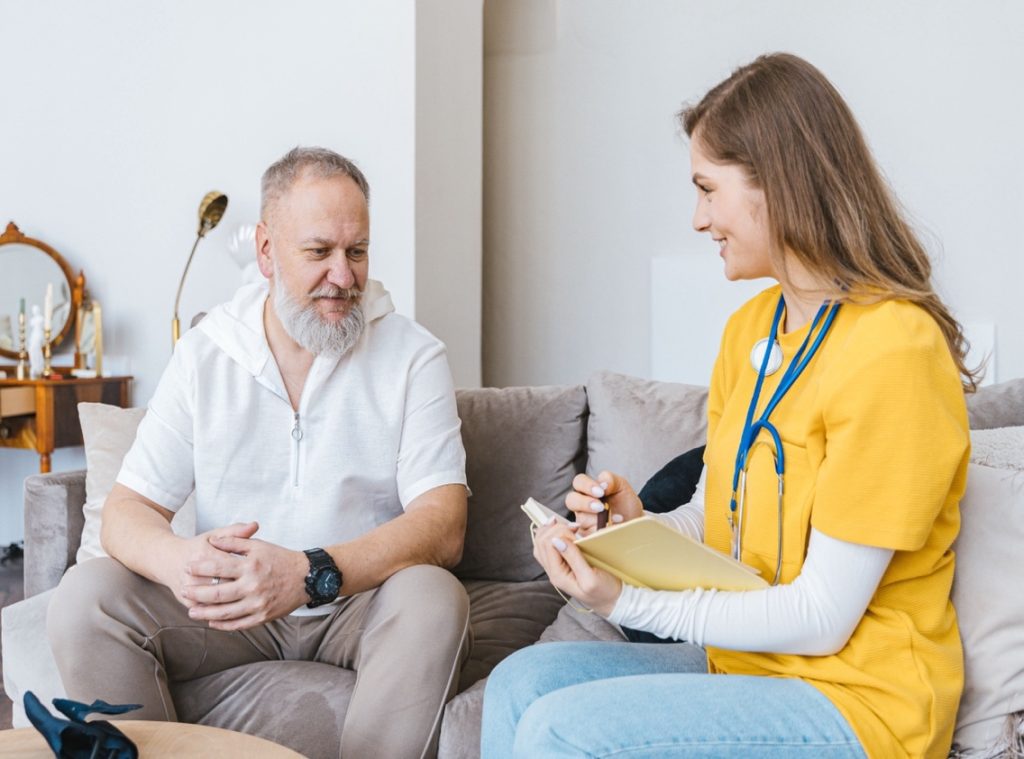
ILLUSTRATIVE PHOTOGRAPH. PHOTO SOURCE:PEXELS.

COMMUNICATION IS MORE THAN WORDS

Have you ever noticed that someone says they are fine, doing well, or that there is nothing to worry about, but their facial expression or behaviour tells us something different?

A person may say, “Fine,” but perhaps they are unusually quiet, look worried, or behave differently from usual.

Non-verbal communication includes facial expressions, eye gaze, gestures, body movements, and posture. These can give us useful information about what a person is communicating. However, we should be careful not to make assumptions. The same gesture can mean different things to different people.

Instead of deciding how a person feels, we can notice the change and ask respectfully.

For example we can ask, 

“I notice that you are quieter today. Would you like to tell me how you are feeling?”

The Finnish Memory Association (Muistiliitto) highlights the importance of non-verbal communication, including facial expressions, gestures, and touch, particularly when a person with a memory disorder has difficulties with speech or understanding language.

Observe, but do not assume. Ask and listen.

EVERYONE COMMUNICATES DIFFERENTLY

There is no single communication method that works for everyone.

Some people communicate mainly through speech. Others may use speech together with gestures, pictures, or signs. Some people may use AAC (Augmentative and Alternative Communication).

AAC can include pictures and symbols, communication boards, gestures and signs, writing, electronic communication devices, or eye gaze.

These methods can help a person express their needs, wishes, feelings, and choices.

For example, a client may find it difficult to answer the question, “What would you like to do today?” Instead of expecting a spoken answer, we could show pictures of different activities. The client can then point to or choose the activity they prefer. This gives the person another way to participate and make their own choices.

The UK organisation “Sense” describes communication as something that can involve many different methods, including speech, signing, gestures, pictures, objects, touch, and technology.

Communication should adapt to the person, not the person to the communication method.

PICTURES, SIGNS, AND SIGN LANGUAGE CAN MAKE COMMUNICATION EASIER

Pictures, symbols, and sign language can make communication easier, especially when communicating with words is difficult.

Pictures and symbols can help a person express what they want or do not want, which activities they prefer, how they feel, and what they need.

Simple signs or sign language can also support communication and help a person express themselves more clearly.

Visual communication can also make information easier to understand. For example, instead of explaining an activity verbally, we can use pictures to show the different steps. This can make situations clearer and support the client’s independence and participation.

The World Health Organization (WHO) emphasises accessible, person-centred communication that responds to people’s different needs.

The purpose of communication is not only to exchange information but also to give every person an opportunity to express themselves.

LISTENING IS ALSO COMMUNICATION

Good communication is not just about talking but it is also about listening.

In a busy healthcare environment, it can be easy to focus on completing tasks quickly. However, sometimes a client needs more time to find the right words, answer a question, or show what they mean.

We can support communication by:

  • giving the person enough time.
  • listening without interrupting.
  • using simple language.
  • asking one question at a time.
  • checking that we have understood correctly.
  • encouraging the person to ask questions.
  • using pictures or gestures when needed.

For example: “Could you tell me in your own words?” or “Did I understand correctly?”

These simple questions can help prevent misunderstandings.

The WHO recommends checking whether people have understood the information and being patient when communication takes more time.

SIMPLE LANGUAGE MATTERS

Healthcare professionals often use medical and professional terminology. These words may be familiar to us but difficult for clients to understand. When communicating with a client, we should always use simple and clear language instead of professional terms.

Instead of giving a long explanation, we can make communication easier by:

  • using familiar words.
  • explaining one thing at a time.
  • avoiding unnecessary medical terms.
  • using examples.
  • using pictures when helpful.
  • asking whether the client has understood.

WHO’s communication guidance recommends using plain language, familiar languages, and visual elements to make health information easier to understand.

Communication is successful not when we have explained something, but when the other person has understood it.

THE IMPORTANCE OF TOUCH

Touch can also be part of communication.A gentle and appropriate touch may communicate support, reassurance, or presence. 

The Finnish Memory Association (Muistiliitto) describes touch as one form of non-verbal communication and highlights its possibleimportance when communicating with people living with memory disorders.

However, touch is personal. People have different preferences, cultural backgrounds, and boundaries. Therefore, we should always consider the person’s comfort and wishes.

Good communication means respecting the person’s boundaries and adapting our actions to the individual.

COMMUNICATION AND PEOPLE WITH MEMORY DISORDERS

Communication can become more difficult for people living with memory disorders. A person may have difficulty finding words, understanding questions, or expressing what they want.

Communication does not have to stop in these situations. We can use familiar photographs, music, objects, gestures, facial expressions, simple questions, familiar routines, or appropriate touch. Familiar things can sometimes support communication and create meaningful moments. For example, a photograph of a familiar place may encourage memories and conversation.

The aim is not always to have a long conversation. Sometimes, a shared moment is enough.

COMMUNICATION AND INDEPENDENCE

Communication is closely connected to independence.

Imagine being unable to tell someone one of these things:

“I don’t want this.” or  “I want to go outside.” or “I’m in pain.”

Having a way to communicate these things is important for a person’s dignity and participation. This is why pictures, signs, writing, communication boards, and other AAC methods are not simply “extra tools.” For some people, they are essential ways of expressing themselves.

WHO’s disability-inclusive health guidance emphasises communicating directly with the person, asking how they prefer information to be presented, and recognising the person’s own knowledge about their needs.

The goal is not to speak for the client. The goal is to support the client in speaking for themselves, in whatever way works best for them.
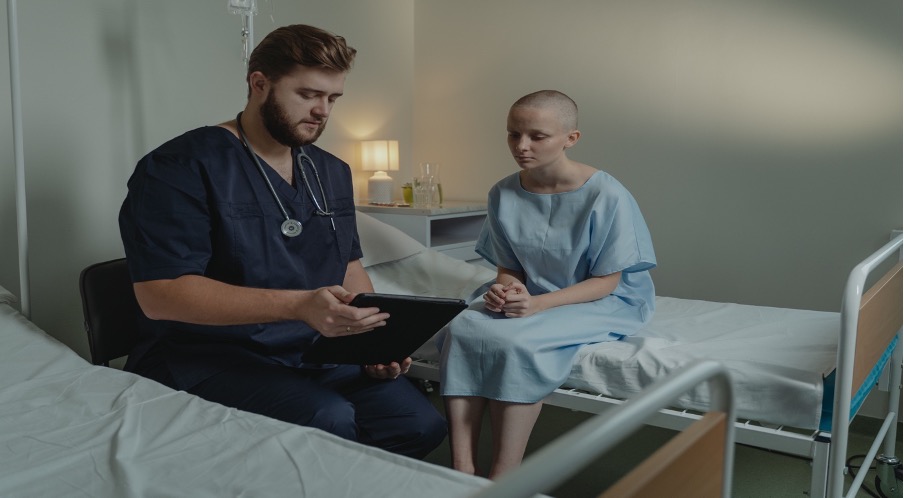
Illustrative photograph. Photo source: Pexels.

RESPECT, DIGNITY, AND AUTONOMY IN COMMUNICATION

One important lesson for healthcare students is that we should not make decisions for a client based only on our interpretation of their behaviour.

  • If a client is quiet, we should not automatically assume that they agree.
  • If a client moves slowly, we should not automatically assume that they are tired.
  • If a client does not answer immediately, we should give them time.
  • If we are unsure, we can ask questions or try another communication method.

The WHO recommends focusing on the person, communicating directly with them, and checking their understanding rather than making assumptions about their needs or abilities.

This is closely connected to respect, dignity, self-determination, and autonomy.

COMMUNICATION IN A MULTICULTURAL ENVIRONMENT

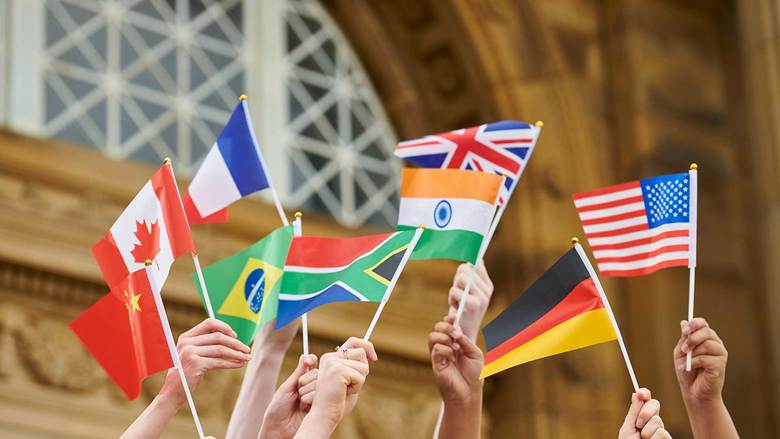
Soteekki is also a multicultural learning environment. Students, professionals, and clients may have different first languages and cultural backgrounds.

For international students, communicating in Finnish can sometimes feel challenging. You may know what you want to say but need more time to find the correct Finnish words. It is okay to ask for help.

Some useful phrases we can use are:

  • “Voisitko puhua vähän hitaammin?”
    Could you speak a little more slowly?
  • “Voisitko toistaa?”
    Could you repeat that?
  • “En ymmärtänyt. Voisitko selittää uudelleen?”
    I didn’t understand. Could you explain again?
  • “Ymmärsinkö oikein?”
    Did I understand correctly?

The WHO also emphasises using familiar languages and adapting communication to the needs of the intended audience.

Good communication does not require perfect language. It requires patience, respect, listening, and a willingness to understand each other.

FINAL THOUGHT

As future professionals in social and healthcare services, we should remember that communication is a shared process.We need to adapt our communication to the individual person and give them opportunities to express their own wishes, needs and feelings.

When words are not enough, communication does not end. We simply need to find another way to listen and give the person a chance to be heard.

References

  1. Avustajaklinikka. (2026, September 17). Miksi sanaton viestintä on ratkaisevaa avustustilanteissa? Avustajaklinikka.
  2. Communication Hub. (n.d.). Ways we communicate. Communication Hub.
  3. ECL. (2026, September 22). Beyond words: Why every way of communicating matters. https://www.ecl.org/media-area/blog/beyond-words-why-every-way-of-communicating-matters
  4. Muistiliitto. (n.d.). Kosketus ja sanaton viestintä. Muistiliitto.
  5. Sense. (n.d.). Ways of communicating. Sense.
  6. University of Mississippi Medical Center. (n.d.). Alternative means of communication. University of Mississippi Medical Center.
  7. World Health Organization. (n.d.). Module 4 Part 2: Strategies and good practices in disability-inclusive communication in health care. World Health Organization. https://iris.who.int/server/api/core/bitstreams/b90d6e84-171a-4ebf-aaae-77828c5d779a/content
How Does Welfare Technology Enhance The Well-Being of Adults

By Tharaka Palayangodage, Fernando Kumaragewattage & Kahalle Widanage Udeepa

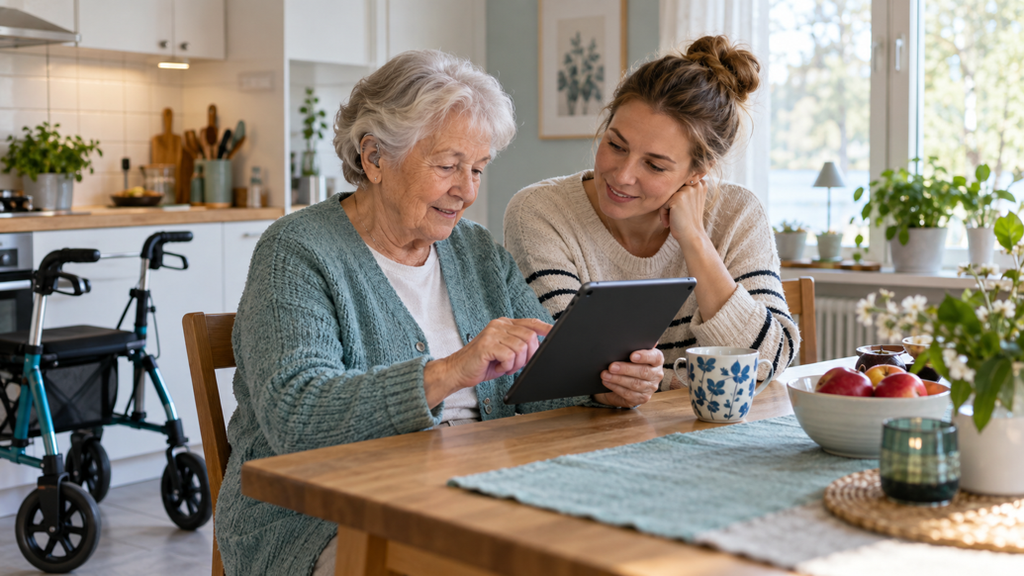
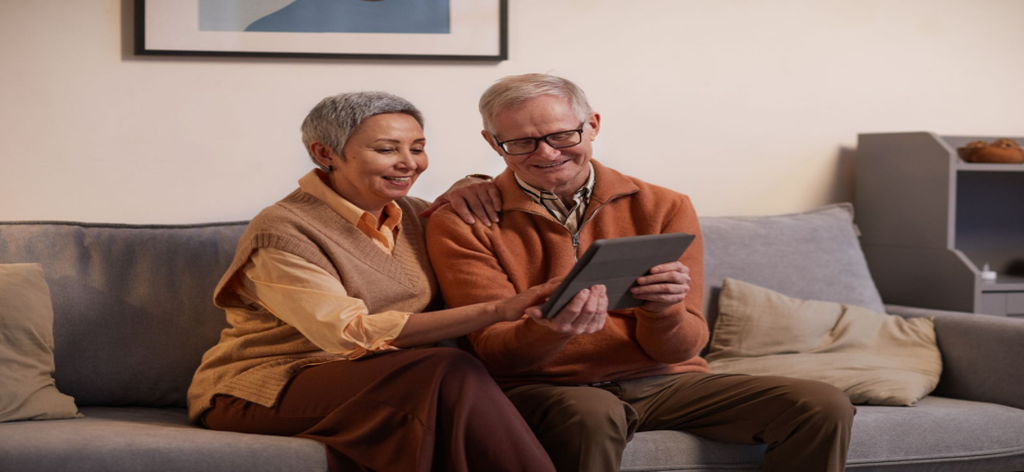
Figure 1. Older adults sharing a tablet. Photograph: Marcus Aurelius (2021), Pexels.

Introduction

Welfare technology can make ordinary activities easier, support safety and help people stay connected. It includes familiar products such as rollators and video calls as well as alarms, reminders and remote monitoring (Nordic Welfare Centre, n.d.). A useful device is not simply one that is available; it must match the person’s own goal, abilities and support network.

This blog has three parts. First, we explain everyday uses. Second, we examine safety, health and independence, including what research can and cannot prove. Third, we consider social well-being, digital skills, privacy and the importance of human contact.

The three topics

Part 1 – Welfare Technology in Everyday Life

Part 2 – Supporting Safety, Health and Independence

Part 3 – Social Well-Being, Challenges and Responsible Use

Part 1 – Welfare Technology in Everyday Life

By Tharaka palayangodage

Figure 2. Everyday mobility and reminders. AI-generated editorial illustration; not a real person.

Welfare technology is technology used to maintain or improve security, activity, participation or independence for older people and people with disabilities (Nordic Welfare Centre, n.d.). It is broader than a single gadget: fitting, instruction and follow-up matter too. The World Health Organization (WHO, 2024) calls assistive technology an umbrella term covering products and the services around them.

Think of a person who wants to water plants, telephone a relative and remember an appointment. A rollator may support movement around the home; a video call can support contact; and a simple reminder can prompt a chosen routine. These are possible uses, not guaranteed outcomes for every person (Nordic Welfare Centre, n.d.).

Practical examples

• Mobility aid: a correctly selected rollator may help someone reach everyday activities.

• Reminder: a phone or clock prompt may support an agreed appointment or routine.

• Communication: video calls and accessibility settings may help a person keep in touch.

• Home controls: accessible lighting or door controls may make some actions easier.

The starting question is “What does this person want to do?” Their preferences, physical environment and ability to obtain help should guide the choice. WHO (2024) notes that costs, limited awareness and gaps in services can prevent access, even when suitable technology exists.

Part 2 – Supporting Safety, Health and Independence

By Fernando Kumaragewattage

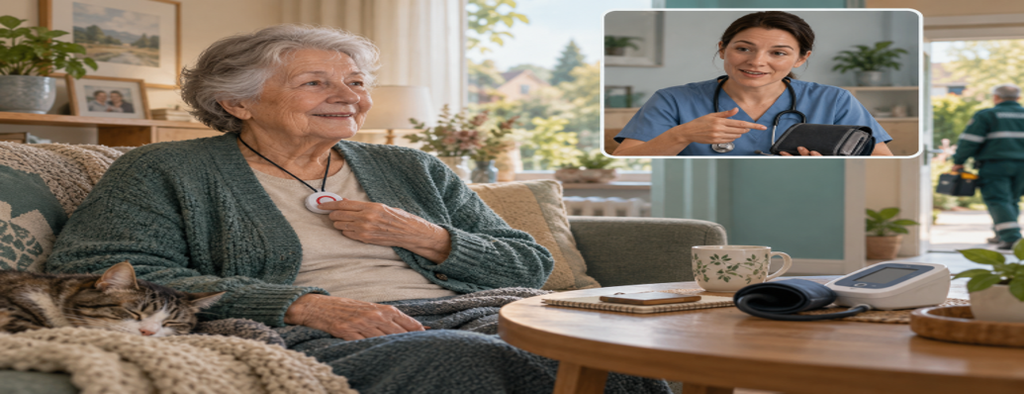
Figure 3. Alert, measurement and care response. AI-generated editorial illustration; the devices do not show clinical results.

Safety. A personal alarm or movement sensor can send a request for help. An alert is useful only if someone receives it and knows what to do; the response plan and a backup for device failure are just as important as the device itself (Nordic Welfare Centre, n.d.).

Health. Home measurements and medication support can help with an agreed care plan, but a reading or reminder should not be treated as a diagnosis or a substitute for professional assessment. In a Finnish assisted-living study, medicine-dispensing technology was associated with less time spent on medicine tasks, not with more measured direct care time; night monitoring was associated with more direct night care and fewer night staff (Väisänen et al., 2026).

Independence. Matching a mobility aid, accessible communication or a home control to a person’s goal may help preserve choice and daily function (WHO, 2024). Yet evidence does not show that every technology package automatically improves outcomes. In the ATTILA randomized trial of 495 people with dementia, a full assistive-technology and telecare package did not significantly prolong living at home compared with a basic package (Gathercole et al., 2021).

Read the findings carefully: the Finnish study was observational and did not directly test residents’ safety outcomes; ATTILA tested specific packages for people with dementia, not every device in every setting. Staff capacity, the person’s preferences and follow-up still matter (Gathercole et al., 2021; Väisänen et al., 2026).

Part 3 – Social Well-Being, Challenges and Responsible Use

By Kahalle Widanage Udeepa

Figure 4. Video contact with human support. AI-generated editorial illustration; not a photographed client.

A video call can offer a way to speak with a friend or family member when travel is difficult. But connection is more than access to a screen. WHO (2025) describes loneliness as the painful gap between desired and actual relationships; its report says the effect of digital technology on social connection is mixed and depends on how it is used. A device should add to meaningful contact, not displace visits or a person’s preferred activities.

Digital skills are an access issue. Small text, hearing or vision changes, confusing menus and lack of confidence can make a seemingly simple app difficult. We would begin with one action the person wants to learn, show it slowly, then ask them to try it. The teach-back or show-me approach checks whether our explanation was clear; it does not test the person (Agency for Healthcare Research and Quality, 2024).

Privacy matters especially when technology collects location, health information or images. Health information needs particular protection, and EU data-protection principles require personal data to be limited to what is necessary for its purpose (European Data Protection Board, n.d.). Before using a connected device, the care team should explain in plain language what it records, who can see it and what happens if it stops working. The person’s choice and the organisation’s rules must guide use.

For example, a person might prefer one weekly video call and a regular face-to-face activity, while declining a camera in their home. This is a suggested scenario, not a report of a Soteekki client. Respecting that choice is part of responsible care.

Conclusion

The strongest approach starts with the person’s own goal. Welfare technology may support daily activity, safety, independence and communication, but the benefits depend on fit, training, response and review. Research offers useful guidance without making every device a guaranteed solution; privacy and human relationships remain essential (Gathercole et al., 2021; WHO, 2025).

References

Agency for Healthcare Research and Quality. (2024, April). Use the teach-back method: Tool 5. https://www.ahrq.gov/health-literacy/improve/precautions/tool5.html European Data Protection Board. (n.d.). Data protection basics. https://www.edpb.europa.eu/sme/learn-the-basics/data-protection-basics_en

Gathercole, R., Bradley, R., Harper, E., Davies, L., Pank, L., Lam, N., Davies, A., Talbot, E., Hooper, E., Winson, R., Scutt, B., Ordonez Montano, V., Nunn, S., Lavelle, G., Lariviere, M., Hirani, S., Brini, S., Bateman, A., Bentham, P., . . . Howard, R. (2021). Assistive technology and telecare to maintain independent living at home for people with dementia: The ATTILA RCT. Health Technology Assessment, 25(19), 1–156. https://doi.org/10.3310/hta25190 Nordic Welfare Centre. (n.d.). Welfare technology. https://nordicwelfare.org/en/welfare-policy/welfaretech/

Väisänen, V., Karhulahti-Nordström, H., Saukkonen, P., Ruotsalainen, S., Josefsson, K., & Sinervo, T. (2026). Can technology use alleviate workforce needs in Finnish assisted living services? A convergent mixed-methods study of automatic medicine dispensers and night-time monitoring. Journal of Nursing Management, 2026, Article 2309539. https://doi.org/10.1155/jonm/2309539 World Health Organization. (2024, January 2). Assistive technology. https://www.who.int/news-room/fact-sheets/detail/assistive-technology

World Health Organization. (2025). From loneliness to social connection: Charting a path to healthier societies (plain-language summary). https://cdn.who.int/media/docs/default-source/who-commission-on-social-connection/whocsc-plainlanguage-en_comp.pdf?sfvrsn=c5396dff_6

Image credit

Aurelius, M. (2021, February 11). Man and woman sitting on sofa while looking at a tablet computer [Photograph]. Pexels. https://www.pexels.com/photo/man-and-woman-sitting-on-sofa-while-looking-at-a-tablet-computer-6787960/

Figures 2–4 were generated for this blog in September 2026. They depict imagined situations and are not evidence of measured benefits. Source information checked 23 September 2026.

Human Skills AI Cannot Replace

By: Thiwantha Nawaratne, Dewmini Rathnayake

Why empathy, ethical judgment, creativity and human connection still matter in the age of AI

Artificial intelligence is becoming a bigger part of our everyday lives. It can write, summarise, analyse data, recognise patterns and complete many repetitive tasks faster than humans. AI is developing extremely quickly, and it is changing the way we study, work and communicate.

But as AI becomes more powerful, an important question remains:

What can humans still do that AI cannot truly replace?

The answer lies in some of our most human qualities — our emotions, experiences, relationships, values and sense of responsibility.

According to the World Economic Forum’s Future of Jobs Report 2025, skills involving human interaction, empathy, judgment and creativity have low potential for substitution by current AI.

So, what makes these skills so important?

Empathy: Understanding How Others Feel

Empathy means being able to understand another person’s feelings and respond with care.

AI can recognise words and patterns in communication, but it does not experience emotions as humans do. A person can notice body language, tone of voice and small changes in behaviour.

For example, imagine a colleague who suddenly becomes very quiet during a meeting. A human may notice this change and think, “Is everything okay?” They may decide to talk to the person and offer support.

This kind of understanding is especially important in healthcare, education, social services and customer service.

Empathy helps us understand people’s feelings, notice when someone needs help, provide emotional support and build trust. AI can support communication, but genuine empathy comes from human experience.

Ethical Judgment: Making Difficult Decisions

AI can analyse a huge amount of information and give recommendations. However, difficult decisions are not always about finding the fastest or most logical answer.

Sometimes there is no perfect solution.

Humans need to think about what is right and fair, how a decision may affect other people, and who should take responsibility for the final choice.

For example, in healthcare, a nurse may need to consider a patient’s wishes, safety, dignity and privacy at the same time. AI can provide useful information, but the human professional must use their judgment and take responsibility for the decision.

Creativity: Ideas Based on Human Experience

AI can now create pictures, music, stories and other forms of content. It can combine information and produce different versions of an idea.

However, human creativity is often connected to personal memories, emotions, culture and life experiences.

A person may write a song because it reminds them of someone they love. Someone may create a story based on their childhood or design something inspired by their culture.

AI can help develop an idea, but the original inspiration can come from something deeply personal.

Human creativity allows us to express emotions, share experiences, connect different ideas, express culture and imagine new possibilities for the future.

Human Connection and Trust

Another important quality that AI cannot truly replace is human connection.

People want to feel heard, understood and valued. Trust develops through real relationships and shared experiences.

A good nurse, teacher, colleague or leader does more than provide information. They listen, encourage, support and show that they care.

Trust grows when people are present, listen carefully, keep their promises and treat others with respect.

These simple human actions can make a big difference in how people feel and how they connect with each other.

Why These Skills Matter for the Future

AI will continue to make many routine tasks faster and easier. This does not mean that humans will become less important.

Instead, our human skills may become even more valuable.

We do not need to compete with AI in speed. We can use AI as a tool while developing the qualities that make us human.

Empathy, ethical judgment, creativity and human connection will continue to be important in workplaces and everyday life.

How Can We Develop These Skills?

The good news is that these skills can be developed through everyday practice.

Practice active listening: Listen carefully to the other person instead of thinking about your own reply while they are speaking.

Take time with difficult decisions: Think about the situation, other people’s needs and the possible consequences before making a decision.

Create without AI: Try writing, drawing, brainstorming or solving a problem on your own. This helps strengthen independent thinking and creativity.

Spend time with real people: Face-to-face conversations and shared experiences help us develop empathy and understanding.

Be reliable: Keeping promises and being consistent helps build trust.

The Bottom Line

AI is changing the way we live and work. It can make many tasks faster, easier and more efficient. But technology cannot replace everything that makes us human.

Empathy helps us understand people. Ethical judgment helps us make responsible decisions. Creativity allows us to express our ideas and experiences. Human connection helps us build trust and meaningful relationships.

The future does not have to be humans versus AI.

Instead, it can be humans using AI while strengthening the skills that make us uniquely human.

Sources

· World Economic Forum. Future of Jobs Report 2025 — Skills Outlook.

· Workday. 7 Human Skills AI Can Never Replace.

· Plain AI Daily. Jobs AI Can’t Replace in 2026 — citing Anthropic usage data.

· Forbes. 4 Soft Skills AI Can’t Replace (April 2026).

From Asia to Finland: Journey to Becoming a Nurse at SAMK

Source: Graphic Era University (2025) https://geu.ac.in/blog/bsc-nursing-scope-career-opportunities-skills-and-salary

Moving to another country and rebuilding a professional career is never easy. For this person, the journey from Asia to Finland was filled with challenges, hard work, and determination. Today, she works as a nurse in the rehabilitation ward under the neurological department at Satasairaala, proving that persistence and passion can lead to success.

Starting a New Life in Finland

Originally from Asia. she has been living in Finland for almost ten years. She first moved to the northern part of Finland before later settling in west Finland with her Finnish husband.

Even before moving abroad, nursing was already an important part of her life. She became a registered nurse in her home country in the early 2010s. She always knew she wanted to continue working in healthcare. However, building a nursing career in Finland required new studies, language skills, and adapting to a completely different healthcare system.

Choosing SAMK and Studying Nursing Again

In 2019, she began studying nursing at Satakunta University of Applied Sciences. Since she already had a nursing background, she was familiar with the field, but studying in Finland still brought new experiences and challenges.

Her studies became even more difficult when the COVID-19 pandemic began in 2020. Most classes moved online, including presentations and group work. Like many students during the pandemic, she experienced remote learning instead of traditional classroom education.

Despite the situation, she successfully continued her studies and graduated in mid 2020s. According to her, studying nursing itself was not too difficult because of her previous experience, but the biggest challenge was the Finnish language.

The Challenge of Learning Finnish

Language became the most difficult part of her journey. Even though she is married to a Finn, they mostly speak English at home, which limited her daily Finnish practice.

Before fully entering the healthcare field, she worked as a cleaner and later worked with children in mental health services at Attendo. These experiences helped her slowly adapt to Finnish working life.

She explained that the best way to learn Finnish is by speaking as much as possible. She learned most of her language skills during practical training, harjoittelu. Working directly with patients and colleagues gave her confidence and improved her communication skills.

She also mentioned that language can become a major obstacle for many international nursing students in Finland. Some students’ training was even cancelled midway because healthcare jobs require strong communication skills.

From Internship to Full-Time Job

One of the most important moments in this person’s journey happened during her final internship at Satasairaala.

Before her internship ended, the hospital staff approached her and asked about her future plans and offered her a position in the neurological department. For her, this was a proud and emotional moment because it showed that her hard work had been recognized.

At first, she could not fully work independently because she had not yet completed the Lääkehoidon osaamisen varmistaminen (LOve) medication exam required in Finland. After successfully passing the exam, she gained permission to administer medication to patients and became more confident in her professional role.

Working Life in Finland

She mentioned that in her home country, there was more of a hierarchy that was set in place. But in Finland, it was the opposite. She appreciates equal communication from person to person regardless of their occupation (e.g. doctor, nurse, physiotherapist). It gave her an easier time opening up to others about her concerns and even voicing out suggestions that she thinks could benefit the patient. 

It was also highlighted that back in her home country, there tend to be medical devices that are missing or broken which prevents faster and more efficient care. Finland on the other hand, live up to the reputation of having the best healthcare system there is. Machines used in healthcare are present and are well maintained. Moreover, the prognosis of recovery was better than what she knew from back home due to Finnish healthcare’s intensive and multidisciplinary rehabilitation.

The Most Rewarding Part of Nursing

For this person, the most rewarding part of her career is the positive feedback she receives from patients and colleagues. She shared that hearing patients appreciate her care makes her feel proud of her work.

Even small moments, such as a patient mentioning her positively before leaving the hospital, become meaningful rewards. Positive comments from occupational therapists and coworkers also motivate her to continue improving.

These experiences remind her why she chose nursing as her profession many years ago.

Source: Edge Hill University (2026) https://www.edgehill.ac.uk/departments/support/international/

Advice for International Students

This person’s story (even while anonymous) is inspiring for many international students who hope to build a career in Finland. Her journey shows that success does not happen immediately. It requires patience, courage, and continuous learning.

Her biggest advice is to practice Finnish as much as possible and do not be afraid to speak. Mistakes are part of the learning process, and confidence grows with experience. Don’t be pressured because sometimes you may learn better when you are relaxed.

Next, she suggests that when a student does their traineeship in a workplace, they should make an impression. Students can do this by showing that they take initiative, showing they are motivated to learn, and always up to do work tasks. She says students can also take initiative by asking if there is a job vacancy available in that workplace.

Another thing that she noticed is that students should not be afraid to ask questions regarding nursing care. She added that employees enjoy it more when a student has lots of questions. If you are unsure about something, ask.

From being a registered nurse in Asia to becoming a registered nurse in Finland, Her journey reflects determination, resilience, and the importance of never giving up on your goals.

Nilam Lama K C, Raphaela Alessandra Mendoza

Surviving Vappu: A Nursing Student’s Guide to Health and Community

Wencen Yan, Jin Peng (Nursing students)

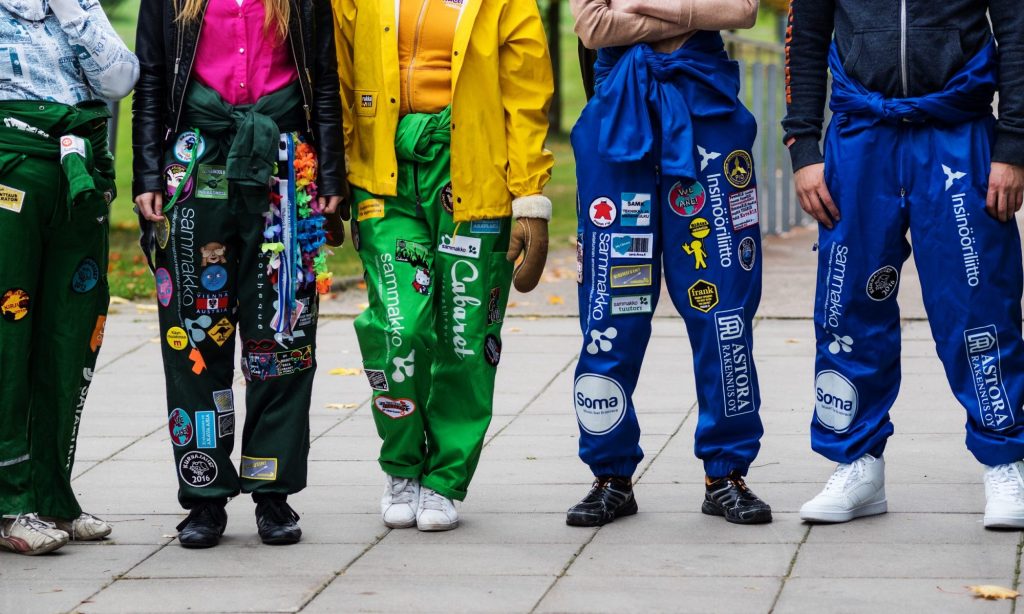
Have you heard of Vappu? For many international students, it can be a big culture shock. In Finland, Vappu (May Day) is not just a one-day holiday. It is a massive student celebration that can actually last for weeks! For example, some universities start their events in mid-April and celebrate every day until the 1st of May.

Figure 1. SAMK-opiskelijaelamaa-Haalarit (SAMK Matkailu, 2026)

As international nursing students studying in Pori, we want to share some tips on how to enjoy this amazing time while taking care of your health and finding your place in the community.

Before we talk about health, let’s explain some Finnish student traditions:

  • Haalarit: These are the colorful student overalls you see everywhere. Different colors mean different study fields.
  • Sima: A sweet, traditional Finnish drink made for Vappu. It is very delicious!
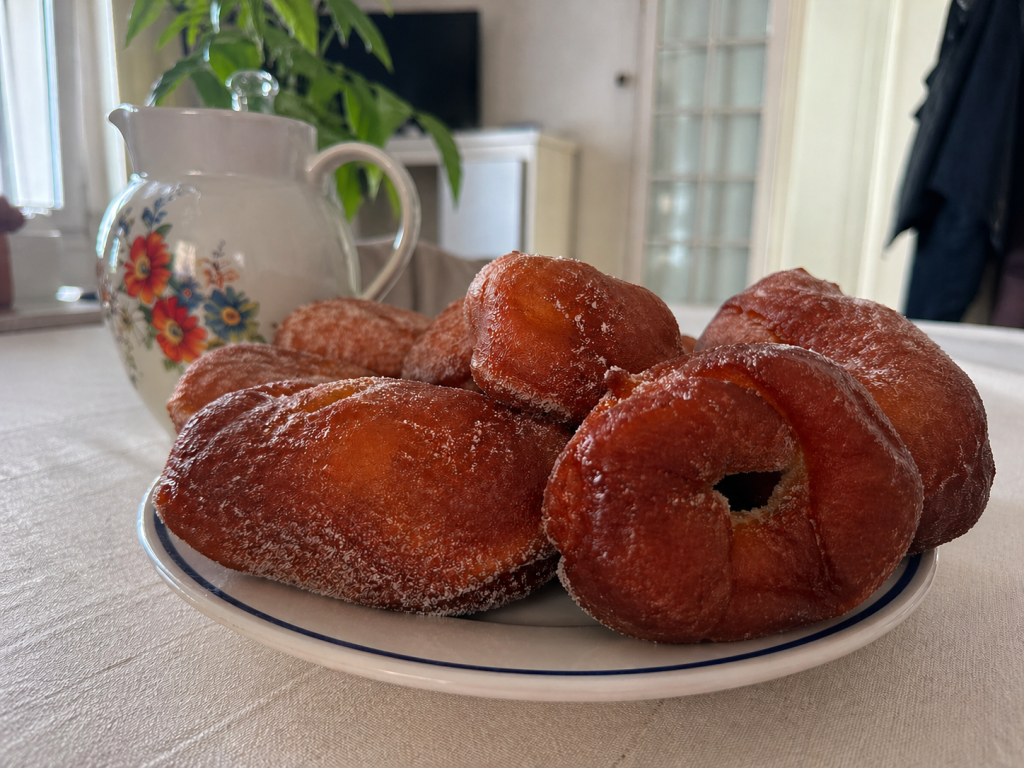
  • Munkki: These are sweet, deep-fried Finnish donuts covered in sugar. Eating a munkki with a glass of sima is a must-do Vappu tradition. They give you a great energy boost for the celebrations, but as nursing students, we remind you to enjoy them in moderation!

Figure 2. Vappu Munkki

Taking Concrete Action to Connect

When you move to a new country, it is easy to stay home, watch shows, and overthink. But Vappu is the perfect chance to take action! Step outside, meet local students, and immerse yourself in the community. You do not need to drink alcohol to participate; there are many fun, non-alcoholic events like picnics or café tours.

Choosing Positive Environments for Mental Well-being

Your mental and social health is just as important as your physical health. The World Health Organization (WHO) defines mental health not just as the absence of illness, but as a state of well-being where you can cope with the normal stresses of life and connect with your community (WHO, 2022).

During a long party season, the social atmosphere can sometimes get overwhelming. It is important to actively choose positive environments. Spend time with good friends who support you and make you feel safe. Studies show that strong social support lowers stress hormones and improves overall health. If an event feels too loud or uncomfortable, it is completely okay to leave. Protecting your personal peace is a great way to practice self-care.

A Nurse’s Evidence-Based Tips for Physical Health

As future healthcare professionals, we must remind you to take care of your body using evidence-based practices during the Vappu weeks:

  • Protect Your Sleep: You cannot attend every single party. According to the Centers for Disease Control and Prevention (CDC), adults need at least 7 hours of sleep per night to maintain a strong immune system (CDC, 2022). Chronic lack of sleep makes your body much more likely to catch viruses.
  • Hydration and Harm Reduction: If you choose to drink alcohol, remember that alcohol causes rapid dehydration. The WHO highlights that the harmful use of alcohol causes significant health issues (WHO, 2018). From a nursing perspective, “harm reduction” is key: pace yourself, and always drink one glass of water for every glass of alcohol. This keeps your kidneys functioning well and prevents severe hangovers.
  • Dress Warmly: Spring in Finland is still very cold, especially at night. Medical research shows that physical exposure to cold temperatures can lower your respiratory tract’s immune defense, making it easier to get sick. Always wear warm, windproof layers under your haalarit.

References:

Centers for Disease Control and Prevention (CDC). (2022). How Much Sleep Do I Need? https://www.cdc.gov/sleep/about_sleep/how_much_sleep.html

SAMK Matkailu. (2026). Matkailun koulutus ja hankkeet. https://matkailu.samk.fi/

World Health Organization (WHO). (2018). Global status report on alcohol and health 2018. https://www.who.int/publications/i/item/9789241565639

World Health Organization (WHO). (2022). Mental health: strengthening our response. https://www.who.int/news-room/fact-sheets/detail/mental-health-strengthening-our-responses

World Suicide Prevention Day: Every Life Matters

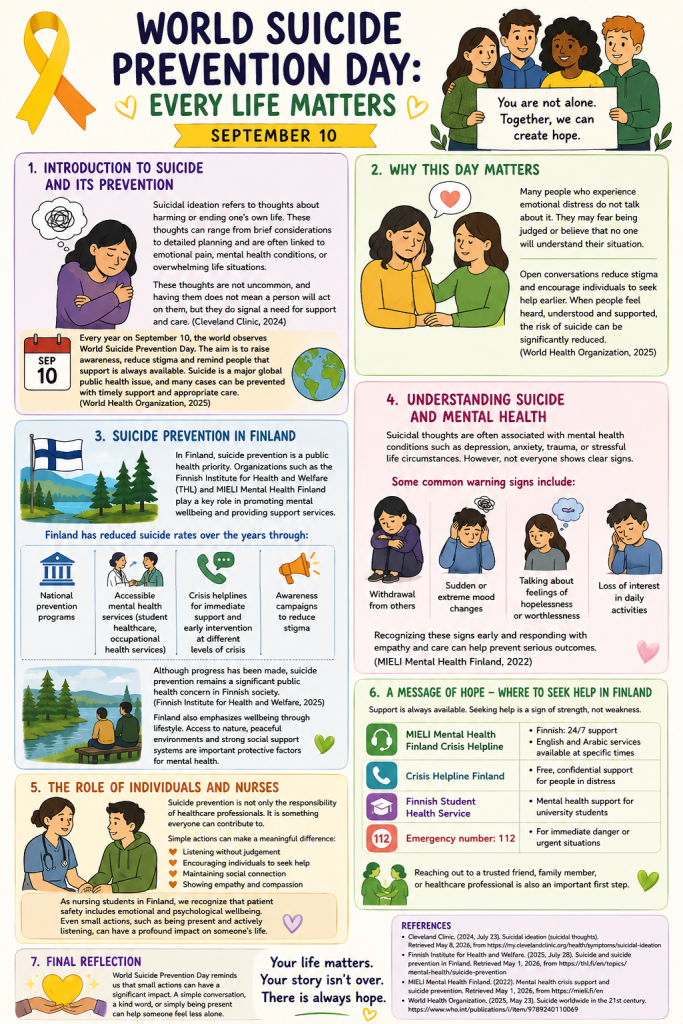
Introduction to suicide and its prevention

Have you ever thought about how someone can look completely fine on the outside but be struggling deeply inside? This is something we started to think about more seriously when learning about mental health and patient safety.

Suicidal ideation refers to thoughts about harming or ending one’s own life. These thoughts can range from brief considerations to detailed planning and are often linked to emotional pain, mental health conditions, or overwhelming life situations. People experiencing suicidal ideation may feel hopeless, trapped, or believe they are a burden to others. Importantly, these thoughts are not uncommon, and experiencing them does not mean a person will act on them, but they do signal a need for support and care. (Cleveland Clinic, 2024)

Every year on September 10, the world observes World Suicide Prevention Day. The aim is to raise awareness, reduce stigma (often influenced by individual experiences and family or cultural beliefs), and remind people that support is always available through increased social awareness and community engagement. Suicide is a major global public health issue, and many cases can be prevented with timely support and appropriate care (World Health Organization, 2025).

Why This Day Matters

Many people who experience emotional distress do not talk about it. They may fear being judged or believe that no one will understand their situation. As a result, they often struggle silently.

Raising awareness is important because open conversations can reduce stigma and encourage individuals to seek help earlier. When people feel heard, understood and supported, the risk of suicide can be significantly reduced (World Health Organization, 2025).

 Suicide Prevention in Finland

World Suicide Prevention Day is also observed in Finland on the same date, September 10. In Finland, suicide prevention is taken seriously as a public health priority.

Organizations such as the Finnish Institute for Health and Welfare and MIELI Mental Health Finland play an important role in promoting mental wellbeing and providing support services.

Finland has reduced suicide rates over the years through:

  • National prevention programs
  • Accessible mental health services (student healthcare, occupational health services)
  • Crisis helplines that provide immediate support, enabling early intervention and helping individuals receive the right level of care at different stages of crisis
  • Awareness campaigns to reduce stigma

Although progress has been made, suicide prevention remains a significant public health concern in Finnish society. (Finnish Institute for Health and Welfare, 2025).

Another important aspect in Finland is the emphasis on wellbeing through lifestyle. Access to nature, peaceful environments, and strong social support systems are recognized as protective factors that contribute positively to mental health.

Understanding Suicide and Mental Health

Suicidal thoughts are often associated with mental health conditions such as depression, anxiety, trauma, or stressful life circumstances. However, not everyone shows clear or visible signs.

Some common warning signs include:

  • Withdrawal from others
  • Sudden or extreme mood changes
  • Talking about feelings of hopelessness or worthlessness
  • Loss of interest in daily activities

Recognizing these signs early and responding with empathy and care can help prevent serious outcomes (MIELI Mental Health Finland, 2022).

The Role of Individuals and Nurses

Suicide prevention is not only the responsibility of healthcare professionals. It is something everyone can contribute to.

Simple actions can make a meaningful difference:

  • Listening without judgement
  • Encouraging individuals to seek help
  • Maintaining social connection
  • Showing empathy and compassion

As nursing students in Finland, this topic has encouraged us to reflect on our future professional roles. We recognize that patient safety extends beyond physical care to include emotional and psychological wellbeing. Even small actions, such as being present and actively listening, can have a profound impact on someone’s life.

A Message of Hope

Even during difficult times, support is always available. In Finland, strong systems are in place to assist individuals who are struggling. Seeking out for help should always be seen as a sign of strength, not weakness.

From where to seek help in Finland

If you or someone you know needs support, help is available:

  • MIELI Mental Health Finland Crisis Helpline
    • Finnish: 24/7 support
    • English and Arabic services available at specific times
  • Crisis Helpline Finland
    • Free, confidential support for people in distress
  • Finnish Student Health Service
    • Mental health support for university students
  • Emergency number: 112
    • For immediate danger or urgent situations

Reaching out to a trusted friend, family member, or healthcare professional is also an important first step.

Final Reflection

World Suicide Prevention Day reminds us that small actions can have a significant impact. A simple conversation, a kind word, or simply being present can help them feel less alone.

Creating a supportive and compassionate society, both globally and in Finland, is essential to protecting lives and promoting mental wellbeing.

References

Cleveland Clinic. (2024, July 23). Suicidal ideation (suicidal thoughts). Retrieved May 8, 2026, from https://my.clevelandclinic.org/health/symptoms/suicidal-ideation

Finnish Institute for Health and Welfare. (2025, July 28). Suicide and suicide prevention in Finland. Retrieved May 1, 2026, from https://thl.fi/en/topics/mental-health/suicide-prevention

MIELI Mental Health Finland. (2022). Mental health crisis support and suicide prevention. Retrieved May 1, 2026, from https://mieli.fi/en

World Health Organization. (2025, May 23). Suicide worldwide in the 21st century. https://www.who.int/publications/i/item/9789240110069

Written By : Kishakya Gunasekara and Chapa Kulasekara, Soteekki Students.

Reflections from Soteekki: Learning, Teamwork, and Friendship

As the Soteekki Blog Team, we are delighted to share the experiences of our students during their time at Soteekki. Over the past weeks, students from diverse study programs and countries came together to learn, collaborate, and grow. Here’s what they had to say about their practice. 

Building Professional Skills and Confidence 

Many students reflected on how Soteekki helped them develop professionally:

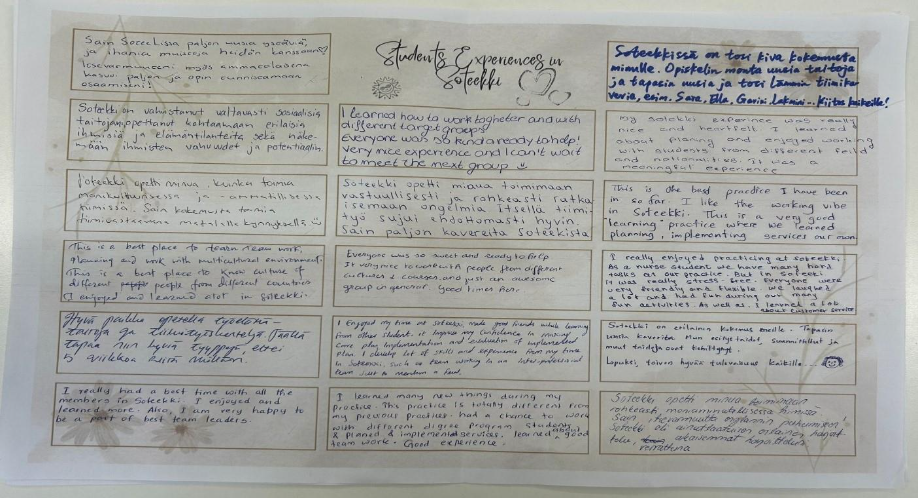
“Sain Soteekissa paljon uusia ystäviä, ja ihania muistoja heidän kansaan. Itsevarmuuteni myös ammattilaisena kasvoi paljon ja opin tunnistamaan osaamiseni!” 

“Soteekki opetti minua toimimaan monikulttuurisessa ja ammattillisessa tiimissä. Sain kokemusta toimia tiimivastaavana matalalla kynnyksellä.” 

“I enjoyed my time at Soteekki, made good friends while learning from other students. It improved my confidence in making care plans, implementation, and evaluation of implemented plans. I developed a lot of skills and experience from my time in Soteekki; such as team working in an inter-professional team, just to mention a few.” 

“My Soteekki experience was really nice and heartfelt. I learned a lot planning and enjoyed working with students from different fields and nationalities. It was a meaningful experience.” 

“This is the best practice I have been in so far. I like the working vibe in Soteekki. This is a very good “learning” practice where we learned planning, implementing services on our own.” 

“I really enjoyed practicing at Soteekki. As a nurse student we have many hard tasks at our practice. But in Soteekki, it was really stress-free. Everyone were very friendly and flexible. We laughed a lot and had fun during our many fun activities. As well as, I learned a lot about customer services.” 

“With Soteekki my experience is super duper. I have met with different types of healthcare students and I learned so many things from them in Soteekki. I love to work as inter-professional team and I love that we have to plan ourselves. I feel like I am working as a profession. Overall, I would say Soteekki is a good place.” 

“My experience at Soteekki is practical and useful. I experienced a handful of experience working with other physios and social students which gave me working experience for inter-professional cooperation.” 

“I had an extraordinary experience here in Soteekki, where I learned new things and even explored myself. And, I am really happy for this opportunity.” 

“Soteekki opetti minua toimimaan rohkeasti moniammatillisessa tiimissa. Sain itsevarmuutta englannin puhumiseen. Soteekki oli ainutlaatuinen erilainen harjoittelu, verrattuna aikaisemmat harjoitteluni.” 

Learning Teamwork and Collaboration 
Students shared how Soteekki strengthened their teamwork and collaboration skills: 

“This is the best place to learn teamwork, planning and work with multicultural environments. This is a best place to know the culture of different people from different countries. I enjoyed and learned a lot in Soteekki.” 

“Hyvä paikka opetella työelämätaitoja ja tiimityöskentelyä. Täällä tapaa niin hyviä tyyppeja, ettei 5 viikkoa riitä millään.” 

“I learned how to work together and with different target groups. Everyone was so kind and ready to help! Very nice experience and I can’t wait to meet the next group.” 

“Soteekki opetti minua toimimaan vastuullisesti ja rohkeasti ratkaisemaan ongelmia. Itsellä tiimityö sujui ehdottomasti hyvin. Sain paljon kavereita Soteekista.” 

“Soteekkissa on tosi kiva kokemusta minulle. Opiskelin monta uusia taitoja ja tapasin uusia ja tosi lämmin tiimikaveria, esimerkiksi: Sara, Ella, Gavini, Lakmini…! Kiitos kaikille.” 

“Soteekki on erilainen kokemus meille. Tapasin uusia kaveria. Mun esitystaidot, suunnittelutaidot ja muut taitoja ovat kehittynyt. Lopuksi, toivon hyvää tulevaisuus kaikille.” 

“Everyone was so sweet and ready to help. It’s very nice to work with people from different cultures and courses. And, just an awesome group in general. Good time here.” 

“I learned many new things during my practice. This practice is totally different from my previous practices, had a chance to work with different degree program students and planned and implemented services. Learned about good teamwork. Good experience.” 

Friendships, Memories, and Community 
Students emphasized the friendships and positive atmosphere at Soteekki: 

“I really had a best time with all the members in Soteekki. I enjoyed and learned more. Also, I am very happy to be a part of best team leaders.” 

“Minulla oli tosi kiva kokemusta Soteekissä SAMK:ssa. Opiskelen monta uusia asioita Soteekista. Tapasin uusia ja tosi lämmin ystäviä, esimerkiksi Sara, Ella, Gavini, Lakmini….! Kiitos kaikille! Kiitos Riikalle, Lisalle ja Ronjalle.” 

A Unique and Meaningful Practice 

Across all experiences, students highlighted how Soteekki differs from other practices: 

“Soteekki opetti minua, kuinka toimia monikulttuurisessa ja ammattillisessa tiimissä. Sain kokemusta toimia tiimivastaavana matalalla kynnyksellä.” 

“Soteekki opetti minua toimimaan rohkeasti moniammatillisessa tiimissa. Sain itsevarmuutta englannin phuhumiseen. Soteekki oli ainutlaatuinen erilainen harjoittelu, verrattuna aikaisemmat harjoitteluni.” 

Final Thoughts from the Blog Team 

Soteekki has been an unforgettable journey for students. It combined learning, teamwork, and friendship in a way that enriched both professional and personal growth. Students leave this practice with new skills, cherished memories, and meaningful connections, prepared to carry their experiences into future careers in healthcare. 

We, the Soteekki Blog Team, Santosh Raya, Ashis Rana and Chinthani Withanachch , thank all students for sharing their reflections and hope that future participants continue to enjoy, learn, and grow in this vibrant learning environment. 

From Belgium to Finland: Exchange Students Experience Learning at Soteekki, SAMK

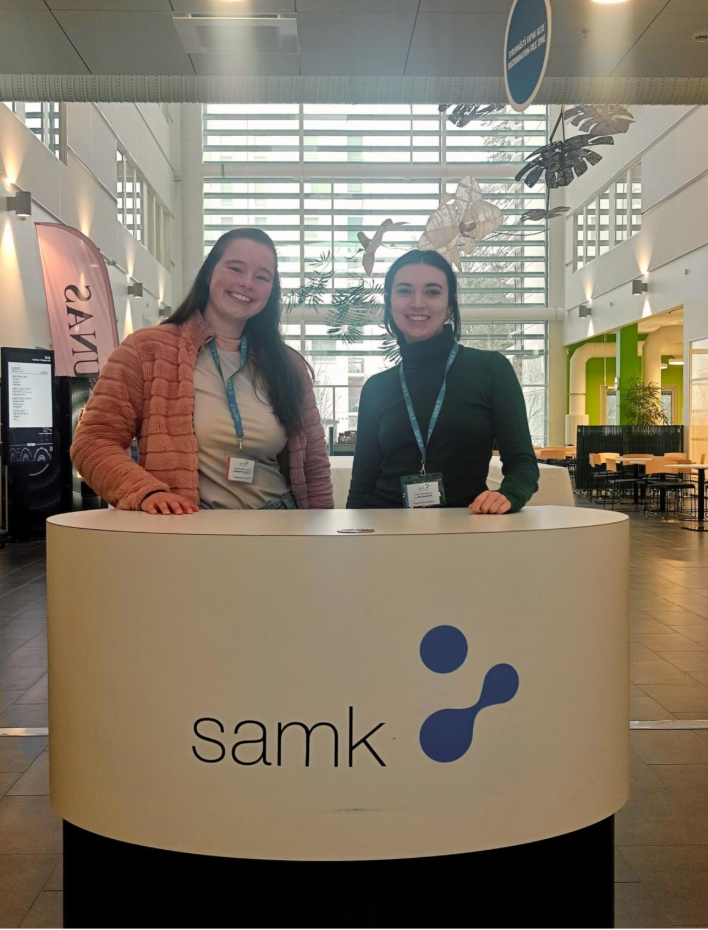
Header Photo Caption: Anneleen Ongenae and Lotte Bosmans exploring the campus of Satakunta University of Applied Sciences during their exchange visit in Pori.

Introduction

International exchange programs offer students the chance to explore new cultures, education systems, and professional practices. Recently, Soteekki at Satakunta University of Applied Sciences, Pori welcomed two exchange students from Belgium: Anneleen Ongenae and Lotte Bosmans.

Anneleen studies Applied Health Sciences, while Lotte is studying Sports and Exercise. During their visit, they experienced Finnish culture, met new people, and explored health, wellbeing and learning environments at SAMK. In this blog, they share their first impressions, challenges, and advice for future international students.

A New Beginning in Finland

Arriving in a new country always brings excitement and curiosity. For Anneleen, the first days in Finland were very positive.

“It was very nice. The hotel was good, the people were very friendly, and we received a warm welcome. It was also great to experience a different culture together.”

For Lotte, the biggest surprise was the Finnish winter.

“It was very nice, but also a bit of a shock because it was very cold. We stayed two days in Helsinki before coming to Pori. I loved the snow and we even went to an ice hockey game. It was really nice.”

After exploring Helsinki, they travelled by bus to Pori, where their exchange activities took place.

“Pori feels much calmer than Helsinki, which I really liked,” Lotte observed.

First Impressions at Soteekki

Anneleen and Lotte described their first week at Soteekki as a mix of excitement and nervousness. While the first day was dedicated to orientation, the full week included various activities that helped them get familiar with the environment: orientation sessions, language support services, student groupings, and information meetings with teachers.

Anneleen shared:

“I was nervous at first but also excited. The International Office at SAMK gave us a warm welcome, and we got to meet different teams, learn how the workshops are organized, and exchange contact details. We were also told to ask for help anytime, which made me feel supported.”

Lotte added:

“I thought it would be big and busy, but it was actually calm and pleasant. Everyone welcomed us with warm smiles, and I found people very friendly and kind. Overall, the first week felt like a roller coaster: sometimes stressful, sometimes exciting, but definitely thrilling.”

These activities helped the students adapt quickly and feel part of the SAMK community, preparing them for the hands-on learning ahead.

Learning Across Cultures

One of the most interesting aspects of the exchange experience was observing cultural differences between Finland and Belgium.

Anneleen noticed that Finnish people are more reserved at first.

“People here are more private and quiet. They may seem shy and don’t open up immediately, but the society feels calm and easy-going. I also noticed there is a strong focus on mental health.”

She compared this with Belgium:

“In Belgium, people are more socially outgoing, and life often feels faster and more rushed.”

Lotte shared similar observations:

“People here seem busy with their own work and tasks. At first they may appear shy, but once you start talking to them, they are very friendly.”

Challenges and Adaptation

Like many international students, Anneleen and Lotte faced some challenges while adapting to a new environment.

For Anneleen, the main difficulties were the winter climate and the language barrier during client interactions.

“The winter and the cold weather were difficult at first. Another challenge was the language barrier when trying to communicate during client services.”

Lotte also found language to be the biggest challenge.

“Sometimes it’s difficult to go outside and talk to people because of the language.”

Despite these challenges, both students stayed open-minded and learned through observation, communication, and practice.

Advice for Future International Students

Based on their experiences, Anneleen and Lotte shared valuable advice for students planning an exchange in Finland.

Anneleen emphasized taking initiative:

“Learn some Finnish before coming. Don’t be afraid to talk to people and make the first move. Sometimes people may not start the conversation themselves, but they are very helpful if you ask. Always ask for help if you need it.”

Lotte offered similar encouragement:

“Learn a little Finnish, be social, and dare to talk to people. Ask for help and just be yourself.”

Conclusion

The experiences of Anneleen Ongenae and Lotte Bosmans show that international exchanges offer much more than academic learning. They provide opportunities to understand new cultures, build confidence, and develop professional skills.

Their journey from Belgium to Finland highlights how curiosity, openness, and a willingness to connect with others can make an exchange experience truly meaningful.

Author: Santosh Raya Nursing Student, Satakunta University of Applied Sciences

National Students’ Mental Health Week: Take Care of Your Mind

Chinthani Withanachchi (Nursing Student)

Student life is an exciting period filled with learning, new experiences, and personal growth. However, it can also be challenging. Many students face academic pressure, deadlines, financial concerns, and sometimes loneliness, especially when studying far from family or adjusting to a new environment. Because of these pressures, mental health plays a very important role in students’ wellbeing and success.

Mental health refers to our emotional, psychological, and social wellbeing. It affects how we think, feel, and act in everyday situations. It also influences how we cope with stress, build relationships, and make decisions. According to the World Health Organization, good mental health allows people to handle normal life stresses and work productively. For students, good mental health helps with concentration, motivation, learning, and maintaining a balanced lifestyle.

Common Challenges Students Face

Many students experience stress during their studies. Exams, assignments, group work, and time pressure can sometimes feel overwhelming. In addition, balancing studies with part-time jobs, family responsibilities, or social life can increase stress levels.

Studies in Finland show that mental health challenges among students have increased in recent years. The Finnish Institute for Health and Welfare reports that anxiety, stress, and feelings of exhaustion are becoming more common among young adults and students. Similarly, the Finnish Student Health Service highlights that many students seek support for issues such as stress, sleep problems, and study-related pressure.

Experiencing stress occasionally is normal, but when stress continues for a long time, it can affect both mental and physical health. Students might notice symptoms such as tiredness, difficulty concentrating, irritability, or trouble sleeping.

Signs You Should Pay Attention to Your Mental Health

It is normal for students to feel stressed or tired during busy study periods. However, sometimes these feelings can become stronger and last longer than expected. Recognizing early signs of mental health challenges can help students take action and seek support before the situation becomes more difficult.

Some common signs that you may need to pay more attention to your mental wellbeing include feeling constantly overwhelmed, losing motivation to study or attend classes, or having difficulty concentrating on tasks. Changes in sleep patterns, such as sleeping too little or too much, can also be a signal that something is not right.

Students might also notice emotional changes such as feeling unusually anxious, sad, irritated, or hopeless. In some cases, social withdrawal can occur, where students avoid meeting friends or participating in activities they usually enjoy. Physical symptoms such as headaches, fatigue, or stomach discomfort can also be connected to stress and mental strain.

If these feelings continue for a longer period or begin to interfere with daily life and studies, it is important to talk to someone and seek support. Services such as the Finnish Student Health Service and information provided by the Finnish Institute for Health and Welfare encourage students to reach out early, as early support can significantly improve wellbeing and recovery.

https://pixabay.com/users/brenkee-2021352

Simple Ways to Support Your Mental Wellbeing

Taking care of mental health does not always require big changes. Small daily habits can make a big difference in how students feel and cope with stress.

First, sleep is extremely important. Getting enough rest helps the brain recover and improves memory and concentration. Many students sacrifice sleep during busy study periods, but regular sleep patterns are essential for mental wellbeing.

Second, physical activity can improve mood and reduce stress. Exercise releases hormones that help people feel happier and more relaxed. Even short walks, stretching, or light exercise can help clear the mind after long hours of studying.

Another important factor is maintaining social connections. Talking with friends, classmates, or family members can provide emotional support and reduce feelings of isolation. Sharing experiences with others can remind students that they are not alone in facing challenges.

Students should also remember the importance of time management and realistic expectations. Breaking large assignments into smaller tasks and creating a study schedule can reduce feelings of being overwhelmed. It is also important to allow time for hobbies, relaxation, and activities that bring joy.

It Is Okay to Ask for Help

One of the most important messages during National Students’ Mental Health Week is that seeking help is normal and encouraged. Many students try to manage stress alone, but support from others can make a big difference.

Universities and student wellbeing services offer counselling, guidance, and support for students experiencing difficulties. In Finland, services such as the Finnish Student Health Service provide mental health support, counselling, and health services specifically designed for students. In addition, student wellbeing centers and learning environments like SOTEEKKI can help promote health, wellbeing, and support among students and the community.

Talking to a teacher, counsellor, nurse, or trusted friend can also be a helpful first step when things feel difficult.

Taking Care of Your Mind Every Day

National Students’ Mental Health Week is a good reminder that mental health should be cared for throughout the year. Taking small steps to support wellbeing can improve both academic performance and overall quality of life.

Students should remember that it is okay to take breaks, rest when needed, and focus on self-care. A healthy mind helps students stay motivated, learn effectively, and enjoy the student journey.

Most importantly, remember this: you do not have to face challenges alone. Supporting each other, talking openly about mental health, and seeking help when needed can create a healthier and more supportive student community. Taking care of your mind today is an investment in your future.

A Message to Students

To every student reading this: remember that your wellbeing is just as important as your academic success. Studying can sometimes feel demanding, but you do not have to be perfect and you do not have to handle everything alone.

Give yourself permission to rest, take breaks, and celebrate small achievements along the way. Taking care of your mind is not a distraction from your studies—it actually helps you learn better, think more clearly, and enjoy your student life more fully.

Be kind to yourself, support your friends, and do not hesitate to ask for help when you need it. Your mental health matters, and taking care of it today will help you build a stronger, healthier future.

References

World Health Organization. (2022). Mental health: Strengthening our response.

Finnish Institute for Health and Welfare. Student mental health and wellbeing in Finland.

Finnish Student Health Service. Student wellbeing and mental health support services.

International Women’s Day: More Than a Celebration

Chinthani Withanachchi (Nursing Student)

Every year on 8 March, the world comes together to celebrate International Women’s Day. It is a day filled with appreciation, flowers, and inspiring messages. But beyond the celebration, it is also a moment to pause and reflect. Who is the modern woman today? What does she carry? And how can we, as a community at SAMK and Soteekki, better support her wellbeing?

International Women’s Day is not only about history and achievements. It is about real women around us — in classrooms, workplaces, homes, and healthcare settings — balancing responsibilities while building their futures.

The Many Roles of a Woman

A woman may be a mother who wakes up early to prepare her child for school before attending lectures. She may be a sister who supports her family emotionally from afar. She may be an employee working evening shifts after a full day of studies. She may be an entrepreneur developing new ideas. She may be a student trying to master assignments, exams, and practical training.

Often, she is all of these at once.

For many women studying at SAMK, life is a constant act of balancing. Finnish students may combine studies with part-time work and family responsibilities. International students may carry an additional emotional weight — adapting to a new culture, learning Finnish, navigating a different education system, and sometimes living far from their loved ones.

Behind every strong woman, there are quiet moments of effort that others may not see.

The Modern Woman in Finland

Finland is known globally for gender equality and opportunities for women. Institutions such as the European Institute for Gender Equality often rank Nordic countries highly in equality comparisons. Women in Finland participate actively in education, politics, healthcare, and business.

However, equality does not automatically remove pressure.

Today’s woman is often expected to succeed academically, grow professionally, maintain social relationships, stay healthy, and remain emotionally strong. Social media adds another layer of comparison. The idea of “having it all together” can become exhausting.

At Soteekki, especially in health and social care education, students are trained to care for others. But an important question remains: who is caring for the caregiver?

Why Women’s Wellbeing Matters

A healthy society depends on healthy individuals. Research from organizations like the World Health Organization highlights how mental and physical wellbeing directly influence productivity, learning capacity, and long-term health outcomes.

When a woman is overwhelmed, exhausted, or unsupported, it affects not only her academic performance but also her confidence and future professional life. When she is supported, respected, and encouraged, she thrives — and so does the community around her.

For students at SAMK, wellbeing is not separate from success. It is the foundation of it.

Image by https://pixabay.com/users/kenahlobo-14528545

Self-Care: Strength, Not Selfishness

One of the most powerful messages of International Women’s Day is that strength is not only about endurance. Strength also means knowing your limits.

Self-care can be simple but meaningful. It may mean allowing yourself to rest without guilt. It may mean saying no when your schedule is full. It may mean asking for academic guidance, mental health support, or simply sharing your stress with a friend. For international students, it may also mean staying connected to your home culture while building a new identity in Finland.

Taking care of yourself does not reduce your value as a student, mother, employee, or professional. It protects it.

A Message to Women at SAMK

To every woman studying at SAMK this International Women’s Day: you are doing more than you think.

You are building knowledge. You are creating opportunities. You are adapting, learning, growing, and contributing.

Your presence in classrooms, training units like Soteekki, workplaces, and communities matters. Whether you are Finnish or international, your journey adds diversity, resilience, and strength to the academic environment.

Let International Women’s Day be more than a celebration. Let it be a reminder that wellbeing is a shared responsibility. Let it encourage conversations about balance, support, and community. And most importantly, let it remind every woman that her value is not measured only by performance — but by her humanity, strength, and courage.

References

European Institute for Gender Equality (2023). Gender Equality Index. World Health Organization (2022). Self-care interventions for health and well-being. United Nations (n.d.). International Women’s Day background and history. Finnish Institute for Health and Welfare (THL) (2023). Mental wellbeing and gender.