

By Tharaka Palayangodage, Fernando Kumaragewattage & Kahalle Widanage Udeepa
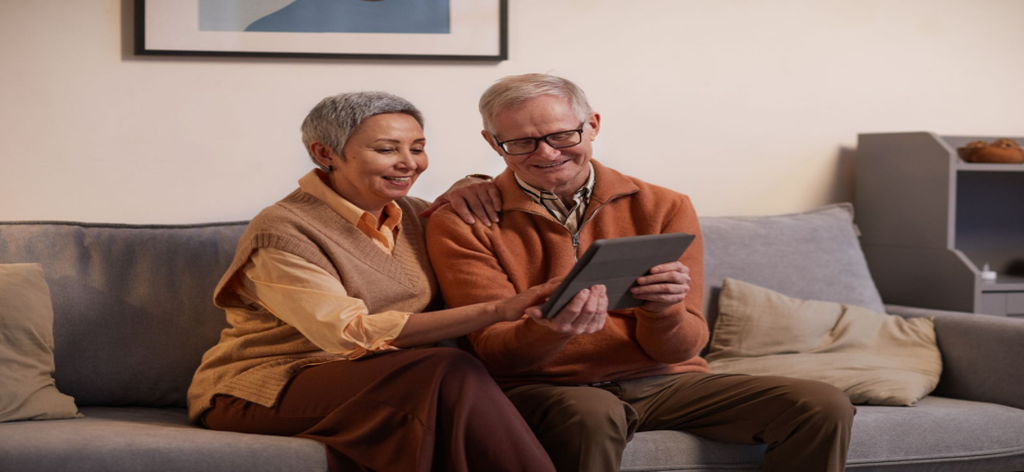
Figure 1. Older adults sharing a tablet. Photograph: Marcus Aurelius (2021), Pexels.
Introduction
Welfare technology can make ordinary activities easier, support safety and help people stay connected. It includes familiar products such as rollators and video calls as well as alarms, reminders and remote monitoring (Nordic Welfare Centre, n.d.). A useful device is not simply one that is available; it must match the person’s own goal, abilities and support network.
This blog has three parts. First, we explain everyday uses. Second, we examine safety, health and independence, including what research can and cannot prove. Third, we consider social well-being, digital skills, privacy and the importance of human contact.
The three topics
Part 1 – Welfare Technology in Everyday Life
Part 2 – Supporting Safety, Health and Independence
Part 3 – Social Well-Being, Challenges and Responsible Use
Part 1 – Welfare Technology in Everyday Life
By Tharaka palayangodage
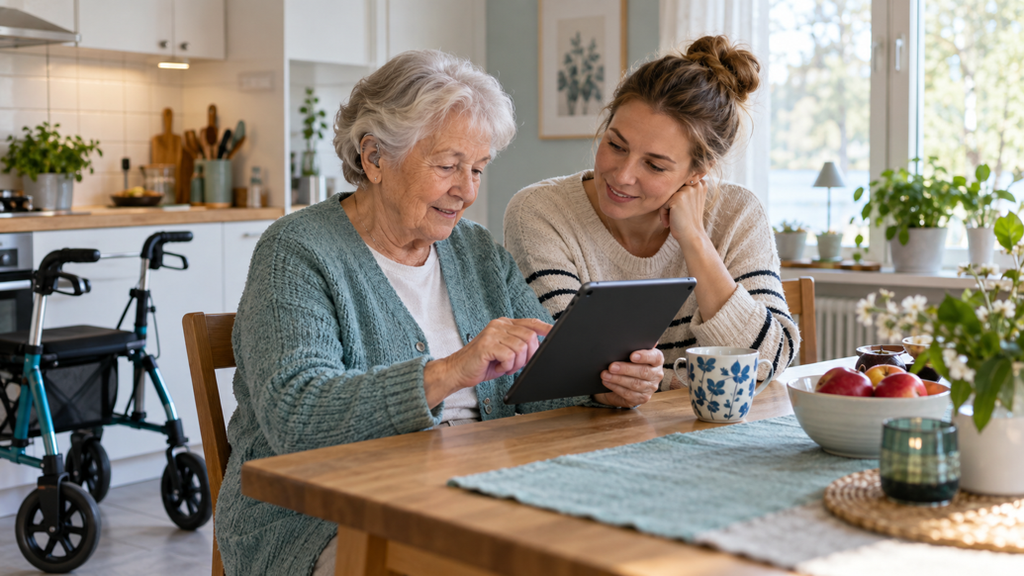
Figure 2. Everyday mobility and reminders. AI-generated editorial illustration; not a real person.
Welfare technology is technology used to maintain or improve security, activity, participation or independence for older people and people with disabilities (Nordic Welfare Centre, n.d.). It is broader than a single gadget: fitting, instruction and follow-up matter too. The World Health Organization (WHO, 2024) calls assistive technology an umbrella term covering products and the services around them.
Think of a person who wants to water plants, telephone a relative and remember an appointment. A rollator may support movement around the home; a video call can support contact; and a simple reminder can prompt a chosen routine. These are possible uses, not guaranteed outcomes for every person (Nordic Welfare Centre, n.d.).
Practical examples
• Mobility aid: a correctly selected rollator may help someone reach everyday activities.
• Reminder: a phone or clock prompt may support an agreed appointment or routine.
• Communication: video calls and accessibility settings may help a person keep in touch.
• Home controls: accessible lighting or door controls may make some actions easier.
The starting question is “What does this person want to do?” Their preferences, physical environment and ability to obtain help should guide the choice. WHO (2024) notes that costs, limited awareness and gaps in services can prevent access, even when suitable technology exists.
Part 2 – Supporting Safety, Health and Independence
By Fernando Kumaragewattage
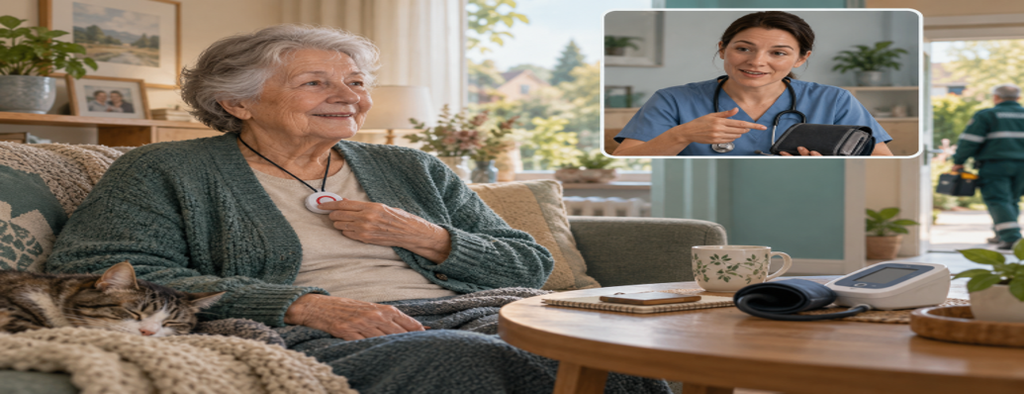
Figure 3. Alert, measurement and care response. AI-generated editorial illustration; the devices do not show clinical results.
Safety. A personal alarm or movement sensor can send a request for help. An alert is useful only if someone receives it and knows what to do; the response plan and a backup for device failure are just as important as the device itself (Nordic Welfare Centre, n.d.).
Health. Home measurements and medication support can help with an agreed care plan, but a reading or reminder should not be treated as a diagnosis or a substitute for professional assessment. In a Finnish assisted-living study, medicine-dispensing technology was associated with less time spent on medicine tasks, not with more measured direct care time; night monitoring was associated with more direct night care and fewer night staff (Väisänen et al., 2026).
Independence. Matching a mobility aid, accessible communication or a home control to a person’s goal may help preserve choice and daily function (WHO, 2024). Yet evidence does not show that every technology package automatically improves outcomes. In the ATTILA randomized trial of 495 people with dementia, a full assistive-technology and telecare package did not significantly prolong living at home compared with a basic package (Gathercole et al., 2021).
Read the findings carefully: the Finnish study was observational and did not directly test residents’ safety outcomes; ATTILA tested specific packages for people with dementia, not every device in every setting. Staff capacity, the person’s preferences and follow-up still matter (Gathercole et al., 2021; Väisänen et al., 2026).
Part 3 – Social Well-Being, Challenges and Responsible Use
By Kahalle Widanage Udeepa
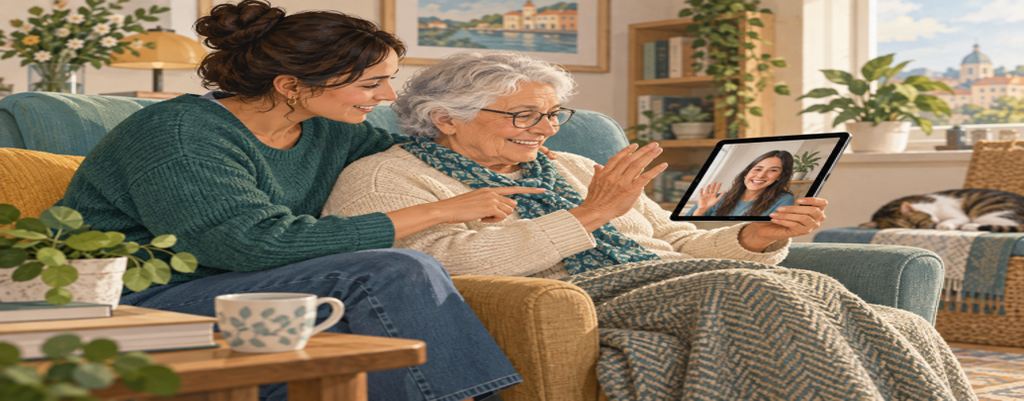
Figure 4. Video contact with human support. AI-generated editorial illustration; not a photographed client.
A video call can offer a way to speak with a friend or family member when travel is difficult. But connection is more than access to a screen. WHO (2025) describes loneliness as the painful gap between desired and actual relationships; its report says the effect of digital technology on social connection is mixed and depends on how it is used. A device should add to meaningful contact, not displace visits or a person’s preferred activities.
Digital skills are an access issue. Small text, hearing or vision changes, confusing menus and lack of confidence can make a seemingly simple app difficult. We would begin with one action the person wants to learn, show it slowly, then ask them to try it. The teach-back or show-me approach checks whether our explanation was clear; it does not test the person (Agency for Healthcare Research and Quality, 2024).
Privacy matters especially when technology collects location, health information or images. Health information needs particular protection, and EU data-protection principles require personal data to be limited to what is necessary for its purpose (European Data Protection Board, n.d.). Before using a connected device, the care team should explain in plain language what it records, who can see it and what happens if it stops working. The person’s choice and the organisation’s rules must guide use.
For example, a person might prefer one weekly video call and a regular face-to-face activity, while declining a camera in their home. This is a suggested scenario, not a report of a Soteekki client. Respecting that choice is part of responsible care.
Conclusion
The strongest approach starts with the person’s own goal. Welfare technology may support daily activity, safety, independence and communication, but the benefits depend on fit, training, response and review. Research offers useful guidance without making every device a guaranteed solution; privacy and human relationships remain essential (Gathercole et al., 2021; WHO, 2025).
References
Agency for Healthcare Research and Quality. (2024, April). Use the teach-back method: Tool 5. https://www.ahrq.gov/health-literacy/improve/precautions/tool5.html European Data Protection Board. (n.d.). Data protection basics. https://www.edpb.europa.eu/sme/learn-the-basics/data-protection-basics_en
Gathercole, R., Bradley, R., Harper, E., Davies, L., Pank, L., Lam, N., Davies, A., Talbot, E., Hooper, E., Winson, R., Scutt, B., Ordonez Montano, V., Nunn, S., Lavelle, G., Lariviere, M., Hirani, S., Brini, S., Bateman, A., Bentham, P., . . . Howard, R. (2021). Assistive technology and telecare to maintain independent living at home for people with dementia: The ATTILA RCT. Health Technology Assessment, 25(19), 1–156. https://doi.org/10.3310/hta25190 Nordic Welfare Centre. (n.d.). Welfare technology. https://nordicwelfare.org/en/welfare-policy/welfaretech/
Väisänen, V., Karhulahti-Nordström, H., Saukkonen, P., Ruotsalainen, S., Josefsson, K., & Sinervo, T. (2026). Can technology use alleviate workforce needs in Finnish assisted living services? A convergent mixed-methods study of automatic medicine dispensers and night-time monitoring. Journal of Nursing Management, 2026, Article 2309539. https://doi.org/10.1155/jonm/2309539 World Health Organization. (2024, January 2). Assistive technology. https://www.who.int/news-room/fact-sheets/detail/assistive-technology
World Health Organization. (2025). From loneliness to social connection: Charting a path to healthier societies (plain-language summary). https://cdn.who.int/media/docs/default-source/who-commission-on-social-connection/whocsc-plainlanguage-en_comp.pdf?sfvrsn=c5396dff_6
Image credit
Aurelius, M. (2021, February 11). Man and woman sitting on sofa while looking at a tablet computer [Photograph]. Pexels. https://www.pexels.com/photo/man-and-woman-sitting-on-sofa-while-looking-at-a-tablet-computer-6787960/
Figures 2–4 were generated for this blog in September 2026. They depict imagined situations and are not evidence of measured benefits. Source information checked 23 September 2026.